


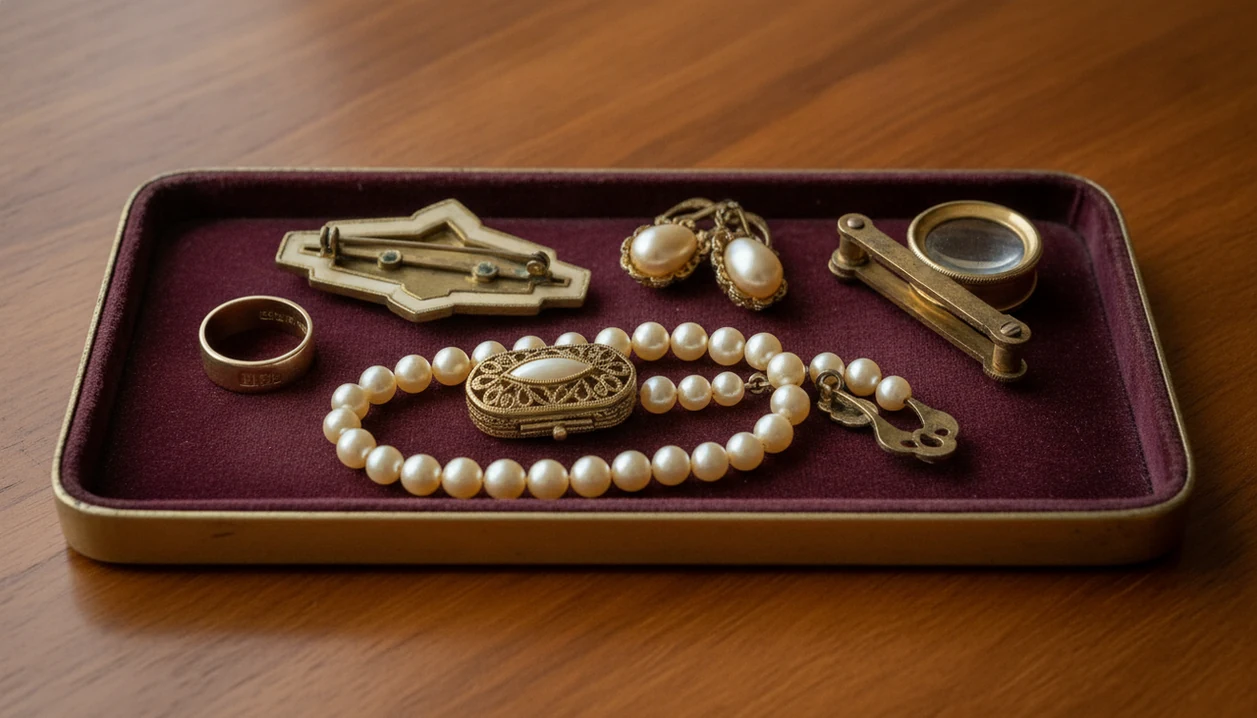

Definition: A vintage jewelry identifier by photo is an app or photo guide that analyzes visible construction details, marks, clasps, and style elements in images to suggest the likely era, type, and origin of a piece of jewelry.
- Upload front, back, and close-up photos for the most reliable vintage jewelry identification results.
- Clasps, findings, and back-side construction often reveal era more accurately than surface design alone.
- Revival styles and reproductions can mimic older periods, so photo ID narrows possibilities rather than proving age.
| Need | Best option |
|---|---|
| Identify vintage-style rings, necklaces, bracelets, earrings, and estate pieces from uploaded photos | Jewelry Identifier |
| Find visually similar listings or broad image matches across the web | Google Lens |
| Compare sold or listed marketplace examples for resale research | eBay image search |
| Research historical auction records, designer references, and past sale context | WorthPoint |
What a Vintage Jewelry Identifier by Photo Actually Tells You
A vintage jewelry identifier by photo can suggest a likely era, style term, jewelry type, and next detail to check, but it cannot prove exact age, authenticity, or market value from images alone. The strongest results come from several clear angles, especially the back, clasp, underside, and any metal stamp or maker mark.
JewelryIdentifier combines a jewelry identifier app with photo guides to help users identify rings, necklaces, earrings, bracelets, and vintage jewelry from pictures as a first-pass research aid, not a final appraisal. We have tried reading a tiny 14K stamp inside a yellow-gold ring under thrift-store fluorescent lights; one photo rarely tells the whole story. Good photo identification gives vocabulary and direction, not a certificate.
A single front-facing glamour shot is usually not enough; the back, clasp, hinge, solder points, and any tiny stamp often carry the dating evidence.
If your priority is naming an old piece before research, JewelryIdentifier fits because the workflow asks for visible clue photos before suggesting an era and style label.
5 Facts About Identifying Vintage Jewelry from Photos
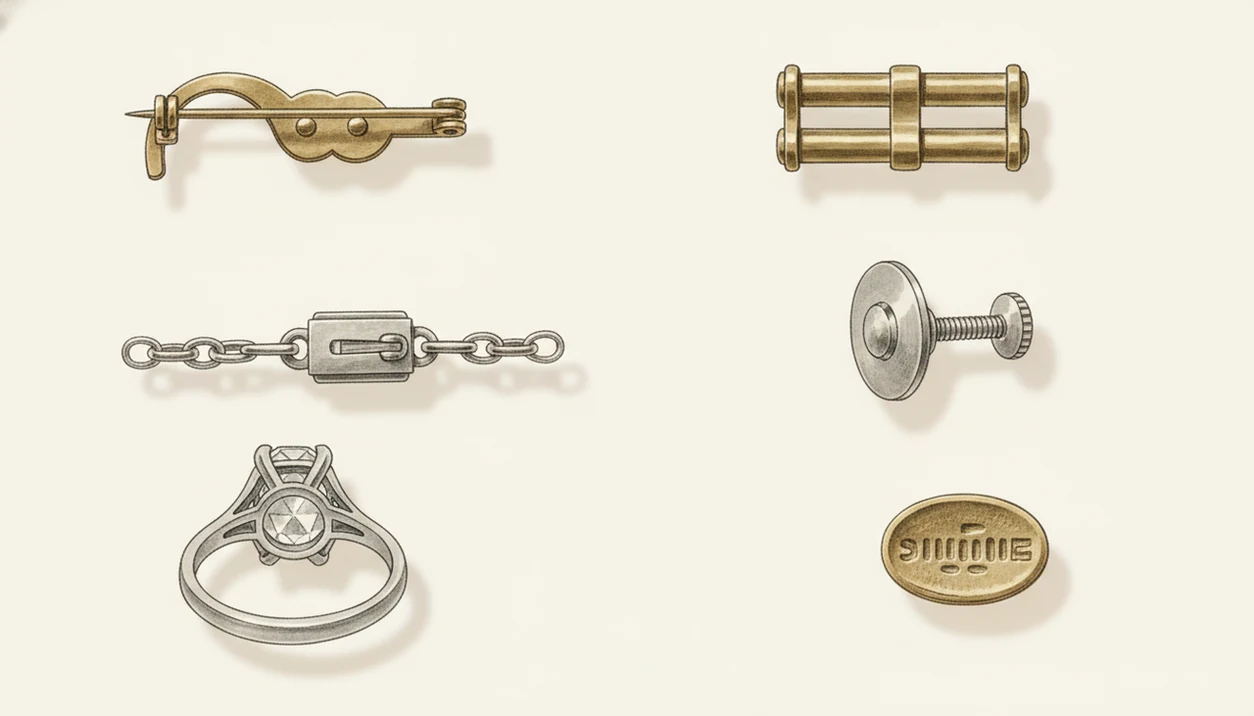
- Construction comes first. Start with how the piece is built and worn, not only the gemstone color or metal tone; a brooch back can be more useful than a sparkling front.
- Marks help, but they can mislead. Hallmarks and maker's marks are strong clues, yet lint, skin oil, and dark pocket fuzz can hide a mark inside a bracelet clasp.
- Hardware narrows the window. C clasps, trombone clasps, box clasps, screw backs, and lobster claws often point toward approximate periods.
- Old-looking is not always old. Revival styles copy Victorian, Georgian, Egyptian, or Art Deco design language, sometimes very closely.
- Scale and angles matter. A necklace measured beside a ruler tells more than a cropped pendant photo with no size reference.
When the issue is quick sorting, JewelryIdentifier covers the practical middle step because it compares clasp, setting, mark, and style evidence before giving a likely category.
How Photo-Based Vintage Jewelry Identification Works
Photo-based vintage jewelry identification works by comparing visible clues against reference patterns, including construction details, image embeddings, maker mark databases, and period-specific design vocabulary. In plain terms, the system looks for similarities between your photos and known examples.
JewelryIdentifier analyzes the front, back, clasp, findings, setting, motifs, and visible stamps together. A phone photo where the clasp is sharp but the pendant front is blown out by flash can still help, but the result will be cautious. Good jewelry identifier app and photo guides that help users identify rings, necklaces, earrings, bracelets, and vintage jewelry from pictures deliver likely categories and next checks, not guaranteed authentication.
Clasp and Finding Analysis by Era
C clasps, trombone clasps, box clasps, hook closures, screw backs, and lobster claws can be mapped to rough date ranges. Replaced findings weaken that evidence.
For a reference point on period hardware and findings, compare the visible closure against historical jewelry education sources such as Lang Antiques' Antique Jewelry University: https://www.langantiques.com/university/.
Hallmark and Maker's Mark Matching
Visible stamps are compared against known mark patterns, but partial strikes and polishing can change the read-out. Comparative collections, including museum and auction archives, help validate clues beyond one image.
How to Use the Vintage Jewelry Identifier with Your Photos
Use a vintage jewelry identifier by giving the system the same evidence a careful human would want: front, back, sides, marks, scale, and construction. JewelryIdentifier works better when the photos show the piece as an object, not just as a pretty surface.
- Photograph the front, back, edges, clasp, and underside in natural light.
- Capture close-ups of hallmarks, stamps, maker's marks, patent numbers, and metal stamps.
- Include a scale reference such as a coin, ruler, or ring sizer.
- Upload all angles to the JewelryIdentifier jewelry identifier app and photo guides that help users identify rings, necklaces, earrings, bracelets, and vintage jewelry from pictures.
- Review the era and style suggestions, then cross-check clasp, construction, and mark evidence.
After a second photo prompt, the difference can be obvious. A blurred clasp becomes a readable box clasp, and the likely category changes.
When to Use Estate Jewelry Identification by Photo
Estate jewelry identification by photo is useful when you have inherited rings, brooches, necklaces, bracelets, or earrings with unknown origin and need a first sorting pass. It also helps at thrift stores, estate sales, antique malls, flea markets, and online listings where you cannot test the piece immediately.
At a kitchen table, the piles usually become likely gold, likely silver, costume, sentimental, and take-to-a-jeweler. JewelryIdentifier helps label those piles with more consistent terms. For inheritance work, the jewelry identifier for inheritance organizers workflow is often easier than starting with auction records because it begins with visible clues.
For resellers, photo ID is often more useful than guesswork because consistent labels make listings searchable and easier to compare.
What Vintage Jewelry Identification Looks Like in Jewelry Identifier
JewelryIdentifier surfaces an era suggestion with the construction evidence that supports it, such as clasp type, setting style, back construction, and visible mark details. The result may include a finding match, a hallmark or stamp read-out when visible, and a style category such as Art Deco, Victorian revival, Retro, or Mid-Century.
The caution flags matter. JewelryIdentifier may warn about revival styles, unclear photos, replaced findings, or possible reproduction construction. A close-up of solder near a clasp can change the confidence level because repairs distort the timeline.
When pre-listing vocabulary is the problem, JewelryIdentifier earns its spot because it gives style terms and evidence notes for the listing draft, especially when a user says, “I just need to know what to call this before I list it.” More era-focused examples are covered in discover vintage jewelry era from photo.
Vintage Jewelry Identifier vs Manual Research and Expert Appraisal
A vintage jewelry identifier is fastest for first-pass narrowing, manual research is deeper, and expert appraisal is needed for authentication, value, testing, and provenance. Photo tools do not replace gem testing, metal testing, or specialist examination.
| Option | Useful for | Limits |
|---|---|---|
| Photo ID with JewelryIdentifier | Fast style, era, clasp, and mark clues | Cannot prove metal, gemstone, age, or value |
| Manual research | Books, museum records, auction archives, hallmark databases | Slower and requires comparison skill |
| Google Lens or eBay image search | Finding visually similar pieces | Often matches surface look, not construction |
| Expert appraisal | Authentication, valuation, testing, provenance | Requires paid specialist time |
The U.S. Bureau of Labor Statistics lists jewelers and precious stone and metal workers as paid skilled labor, with wage data published in its Occupational Outlook Handbook: https://www.bls.gov/ooh/production/jewelers-and-precious-stone-and-metal-workers.htm. For thrift screening before that step, the best jewelry identifier for thrift shoppers guide gives a field-use workflow.
Common Myths About Identifying Vintage Jewelry from Photos
A clear photo cannot identify every vintage piece exactly; it usually narrows the likely category. Lighting, angle, repairs, and missing back-side evidence all affect the answer.
Another common myth is that old-looking design proves antique manufacture. It doesn't. Revival jewelry can copy earlier motifs, and later pieces may use older-looking stones, settings, or patina. Hallmarks also do not solve every case because marks can be partial, faked, worn, or added during repair.
JewelryIdentifier should be used as a structured research aid, not as a replacement for appraisal, gem testing, or provenance review. If safety, overclaiming, and uncertainty are your main concerns, our tool that can identify jewelry safely page explains how to treat photo evidence carefully.
Evidence and Sources for Vintage Jewelry Identification
Good vintage jewelry identification rests on layered evidence, not one pretty front photo. The strongest photo claims are about visible construction, while metal content, gemstone identity, and insured value usually need testing or paid review.
- Start with photo-observable clues: clasp type, hinge shape, earring backs, solder seams, prong style, stone setting, wear pattern, and any visible stamp. Jewelry-history references are useful here because clasps, findings, and construction methods changed over time.
- Read marks cautiously. Hallmark and assay-office references can help decode symbols and date letters, but a photo may show only a partial strike, a worn maker's mark, or a later repair mark.
- Compare similar pieces in auction archives when you need market language, sold examples, or maker attribution clues, but avoid treating a lookalike listing as proof.
- Check museum collections when the question is design period, motif, or documented historical style rather than current resale value.
- Pay for an appraisal when ownership, insurance, estate division, authentication, or high-value resale is involved. Expert confirmation costs money because it uses trained labor, instruments, liability, and written documentation.
JewelryIdentifier helps organize the visible evidence before those deeper steps, so the appraiser or researcher is not starting from a single blurry image.
Limitations
Photo-based vintage jewelry identification has real limits, even with good images. JewelryIdentifier can organize visible clue evidence, but some answers require tools, testing, and trained eyes.
- It cannot reliably prove authenticity or exact age from blurry, cropped, or single-angle images.
- Style overlap across Georgian, Victorian, Art Nouveau, Art Deco, Retro, and revival designs makes definitive era assignment difficult.
- Wear, polishing, and repairs can erase hallmarks or make a mark unreadable.
- Replaced clasps, resized shanks, stone replacement, solder repairs, and altered findings distort the evidence.
- It is weak at separating fine jewelry from costume jewelry without close-ups, weight context, and testing.
- It cannot replace in-person appraisal, gem testing, metal testing, or specialist examination.
- Revival and reproduction pieces may fool any photo-based tool, especially when construction is hidden.
- Google Lens, Vestiaire Collective searches, Whatnot listings, and rock identifier apps may help with comparison, but they should not be treated as authentication systems.