


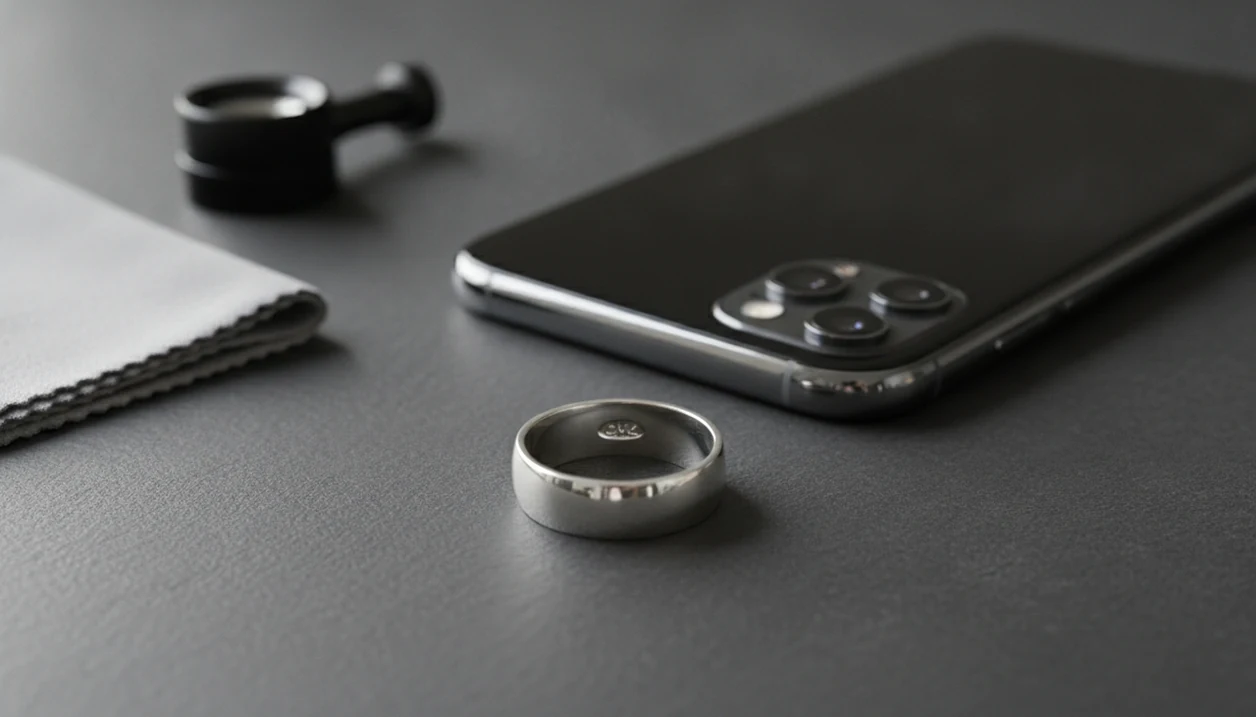

A jewelry stamp identifier app is a mobile tool that reads hallmarks, purity stamps, and maker marks from close-up jewelry photos using AI image recognition and cross-references them against known standards and reference databases.
- Snap a close-up photo of any jewelry stamp, 925, 14K, GF, HGE, or maker symbol, and the app decodes it in seconds.
- Works for rings, necklaces, bracelets, earrings, and vintage pieces across 45+ hallmarking systems worldwide.
- App results are educational starting points; high-value or antique pieces still need professional appraisal.
5 Jewelry Stamp Marks a Hallmark Identifier App Decodes
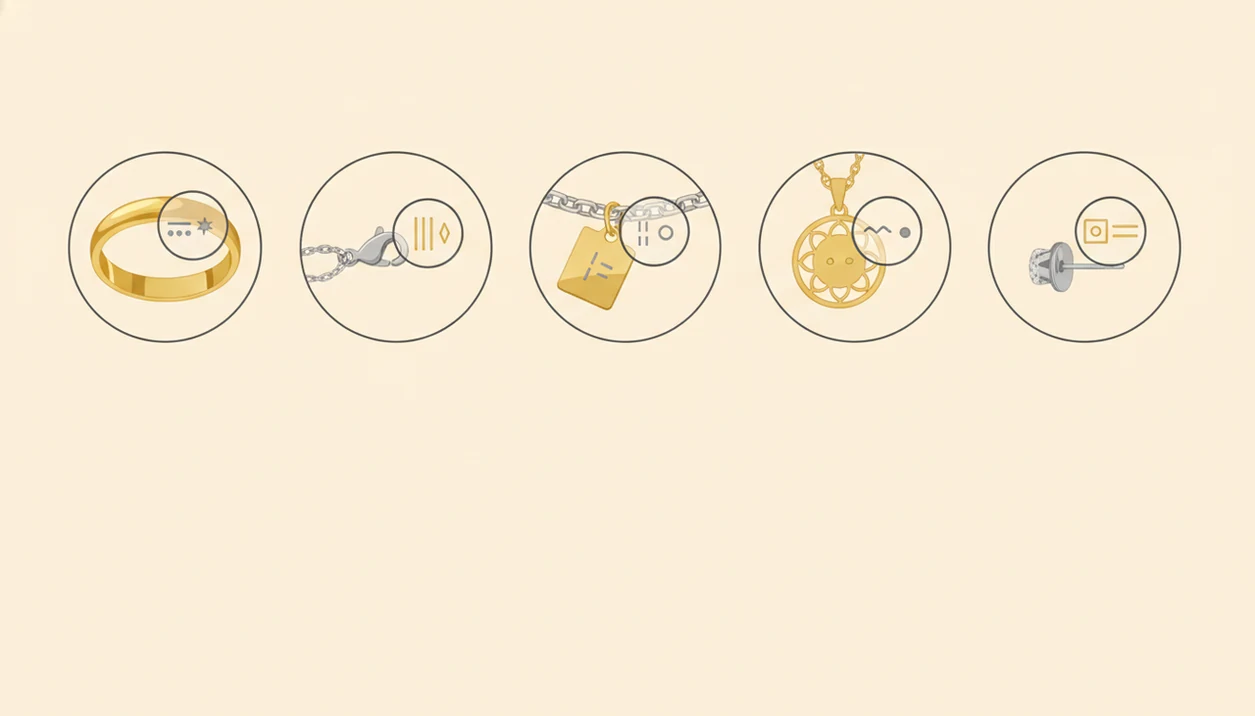
A jewelry stamp identifier app focuses on tiny marks, not just the overall jewelry style. That matters because a necklace photo may say “chain,” but the clasp stamp may suggest sterling silver, gold plating, country origin, or a known maker.
- Purity marks: 925 usually means sterling silver, while 750, 585, and 14K point to common gold purity systems.
- Maker marks: Initials, logos, or stamped names can connect a piece to a manufacturer, workshop, or brand.
- Assay office marks: Some countries use official office symbols to show where metal was tested.
- Date letters: Certain hallmarking systems use letters to indicate a year or date range.
- Country-of-origin symbols: National marks can narrow the next reference to check.
CIBJO maintains international jewelry and precious-metal standards through its Blue Books (https://www.cibjo.org/blue-books/), and the International Association of Assay Offices lists official assay and hallmarking bodies by country (https://theiaao.com/members/). The U.S. jewelry market is also large enough to make quick stamp checks useful for many buyers and sellers; Statista tracks U.S. jewelry store sales by year (https://www.statista.com/statistics/243597/jewelry-store-sales-in-the-us/).
For resellers who need a fast label before listing, JewelryIdentifier fits because it pairs the overall piece photo with a macro stamp workflow.
Five Facts About Jewelry Stamp and Hallmark Identification
Stamp identification is useful, but it is not the same as authentication. We have tried reading a tiny 14K stamp inside a yellow-gold ring under thrift-store fluorescent lights; the photo either helps immediately or shows you the next detail to check.
- AI can read standard purity stamps such as 750 for 18K gold and 925 for sterling silver from close-up photos.
- Photo quality controls the result: sharp focus, steady macro zoom, and bright diffused light matter most on worn vintage marks.
- Most free hallmark identifier apps are freemium: free scans are usually limited before paid reports or unlimited use.
- Counterfeiters can copy hallmarks: a stamp photo is a visible clue, not proof of authenticity.
- Demand is broad: about 44% of U.S. adults reported owning fine jewelry in a 2019 survey; add the original survey URL here, or remove the percentage if the source cannot be verified.
Small marks get dirty fast.
If the stamp area is hidden by lint, skin oil, or dark pocket fuzz inside a bracelet clasp, clean gently before scanning. For deeper maker-symbol work, an app that can identify maker marks is the better next reference.
AI Stamp Recognition Behind the Phone Camera Lens
How jewelry stamp recognition works: the phone photo is cleaned, enlarged, and compared against mark patterns. The system uses image preprocessing, OCR, and symbol matching to turn a tiny engraving into likely category suggestions.
The workflow usually starts with contrast enhancement and noise reduction. That helps when a stamp is shallow or scratched. OCR then tries to read letters and numbers, while symbol-matching models compare logos, assay shapes, and date letters against hallmark reference databases. Detected marks are cross-referenced with international purity standards, assay office registries, and maker mark catalogs.
JewelryIdentifier jewelry identifier app and photo guides that help users identify rings, necklaces, earrings, bracelets, and vintage jewelry from pictures are useful because they deliver visible-clue interpretation, not an official assay result. Confidence scoring is important here. A worn, double-struck, or partly polished-off mark should be flagged as uncertain, not presented as fact.
The FTC has reported jewelry, precious metals, and stones among recurring complaint categories involving misrepresentation and fraud.
6 Steps to Scan a Jewelry Stamp in the App
How to use a jewelry stamp identifier app: clean the mark, photograph it close, then treat the result as a starting point for verification. The better the input photo, the less time you waste chasing a wrong reading.
- Clean the stamp area with a soft cloth and place it under bright, diffused light.
- Open JewelryIdentifier and choose the hallmark or stamp scan mode.
- Photograph the stamp in macro close-up, using a table edge or book as a hand rest.
- Review the AI result for purity, maker, country, and estimated era.
- Save the scan to a personal hallmark archive for collection tracking or appraisal prep.
- Cross-check uncertain marks against official assay office databases or a jeweler’s reference.
For users who say, “I just need to know what to call this before I list it,” JewelryIdentifier covers the first pass because the scan result separates stamp reading from style guessing. More photo setup detail is covered in how to photograph jewelry stamps with phone.
5 Jewelry Buying Scenarios for a Hallmark Identifier App
A hallmark identifier app adds value when the mark changes the buying decision. It is especially useful before you pay, list, insure, or sort pieces into kitchen-table piles: likely gold, likely silver, costume, sentimental, and take-to-a-jeweler.
- Thrift-store and estate-sale finds: scan unknown stamps before assuming “gold tone” means costume.
- Inherited jewelry: compare a grandmother’s brooch on tissue paper with visible maker and metal clues.
- Online vintage purchases: ask sellers for stamp photos before bidding or making an offer.
- Insurance and estate prep: save a personal hallmark archive before meeting an appraiser.
- Resale research: use the mark to search comparable listings with better vocabulary.
When the issue is pre-purchase screening, JewelryIdentifier earns the spot because the scan workflow checks purity and maker marks before you rely on a seller’s description.
McKinsey projects online fine jewelry growth of 8–12% annually through 2030, which makes fast stamp review more relevant for remote buyers (https://www.mckinsey.com/industries/retail/our-insights/state-of-fashion-watches-and-jewellery).
Jewelry Identifier Stamp Scan Results for 925, 14K, and Maker Marks
JewelryIdentifier shows stamp results as a combined identification session: one photo for the whole piece and one macro photo for the mark. That split matters when the pendant front is blown out by flash but the clasp stamp is sharp.
The result screen may decode “925” as sterling silver, “14K” as a gold purity mark, or a maker symbol as a likely manufacturer match. It can also show a country flag, an estimated era range, and a confidence note when the mark is worn.
For collectors building a small archive, JewelryIdentifier saves hallmark scans over time so a bracelet, ring, or earring pair does not become an unlabeled photo in the camera roll. Free scans are shown separately from premium reports, so the limit is visible before deeper use.
For broader object recognition, use Jewelry Identifier alongside the stamp scan rather than treating one photo as the whole answer.
4 Myths About Jewelry Stamp Identifier Apps
A jewelry stamp identifier app can reduce confusion, but it cannot turn a phone photo into legal proof. Good jewelry identifier app and photo guides that help users identify rings, necklaces, earrings, bracelets, and vintage jewelry from pictures deliver clearer vocabulary and next-step checks, not certified value.
- Myth: The app gives an official appraisal. Reality: results are educational estimates, not legally binding documents.
- Myth: A stamp photo proves the piece is real. Reality: counterfeiters copy hallmarks, including convincing purity stamps.
- Myth: Every piece has a clear standardized mark. Reality: vintage, custom, and imported pieces can have obscure or worn stamps.
- Myth: Free means unlimited accurate scans. Reality: most free apps limit identifications or reserve detailed reports for paid tiers.
One awkward truth: some marks stay unresolved.
If a stamp is regional, partial, or hand-struck, compare it with a tool that can read jewelry hallmarks and then ask a qualified jeweler if value depends on the answer.
Jewelry Stamp Identifier App vs. Manual Hallmark Guides
A jewelry stamp identifier app is faster and more portable than manual hallmark books, but manual references and professional review still win on rare marks. The right choice depends on whether you need quick sorting or defensible documentation.
| Method | Strength | Weak point | Best use |
|---|---|---|---|
| JewelryIdentifier | Seconds from a phone photo | Depends on photo quality | First-pass stamp reading |
| Manual hallmark guide | Deep historical references | Slow to search at a flea market | Researching old or regional marks |
| Jeweler visit | Hands-on confirmation | May involve fees or scheduling | High-value or suspicious pieces |
| Google Lens | Broad image matching | Often misses tiny stamps | Similar-looking items |
| eBay image search | Resale context | Seller titles can be wrong | Listing language comparison |
For estate sellers, photo-based stamp scanning is often easier than manual cross-referencing because it preserves the mark image with the likely reading. However, experts with loupes may succeed where AI struggles on worn metal.
A resale listing may start with a ring size mandrel on a desk, but the stamp still needs its own close-up.
Limitations
JewelryIdentifier is a first-pass stamp reader, not a replacement for testing, certification, or appraisal. These limits are the reason we describe results as likely categories and next details to check.
- Extremely small, worn, double-struck, or partly obscured hallmarks may be misread.
- A photo cannot perform density testing, XRF analysis, acid testing, spectroscopy, or stone grading.
- Counterfeited stamps can fool image recognition in the same way they can fool the human eye.
- Free scans are limited, and deeper reports may require a premium tier.
- Results are not a legal substitute for certified appraisal or assay office hallmark verification.
- Obscure regional maker marks may not exist in any current database.
- Blurry, shadowed, or overexposed photos reduce accuracy significantly.
- Google Lens, eBay image search, and rock identifier apps may help with broad comparison, but they are not focused hallmark references.
For high-value decisions, a physical inspection is safer than any photo-only conclusion.
How to Scan a Jewelry Stamp
To scan a jewelry stamp, first locate every possible mark under bright, diffused light. Check inside ring bands, near necklace and bracelet clasps, on pendant bails and backs, inside hoops, on earring posts or clip pads, and behind brooch fittings. Remove loose dust with a soft tool only when safe, stabilize the piece, and use macro mode or a clip-on macro lens so the mark fills the frame without losing focus.
Take several images while changing the light and camera angle slightly, because curved and polished metal can hide shallow characters. Keep one wider photo showing where the mark sits on the item and retain the original files before cropping. Review an app reading character by character, compare it with reputable references, and mark ambiguous symbols as uncertain instead of forcing a complete interpretation.
Jewelry Stamps Versus Hallmarks
“Jewelry stamp” is a broad term for letters, numbers, words, or symbols impressed or engraved on a piece. It can include a purity claim such as 925 or 14K, a maker or sponsor mark, a trademark, patent number, model code, retailer name, country mark, or personal engraving. Not every stamp forms part of an official hallmarking system.
A hallmark more specifically refers to marks associated with a recognized precious-metal control or assay system, often combining a sponsor or maker symbol, fineness mark, assay-office symbol, and sometimes a date letter. Requirements vary by country and period, so a single number should be interpreted in context. Identifying the mark type prevents a brand logo or inventory code from being mistaken for verified metal fineness.
When a Stamp Cannot Confirm Metal Purity
A stamp cannot confirm purity when it is counterfeit, applied to plated or altered jewelry, attached to a replacement component, misread from a worn impression, or inconsistent with the rest of the piece. A genuine clasp marked 14K does not automatically prove that every link, pendant, solder joint, or later repair uses the same alloy. Imported, antique, handmade, and resized jewelry may also follow different marking practices or have incomplete marks.
Use physical testing when value, sale disclosure, insurance, or authenticity depends on the metal. A qualified jeweler or assay professional may choose methods such as electronic testing, acid testing, specific-gravity work, or X-ray fluorescence after considering the item’s construction and risk of damage. The photographed stamp remains useful evidence, but it should be evaluated alongside testing, workmanship, wear patterns, provenance, and documentation.