
Necklace Clasp Types and Dates: Use Closures as Identification Clues
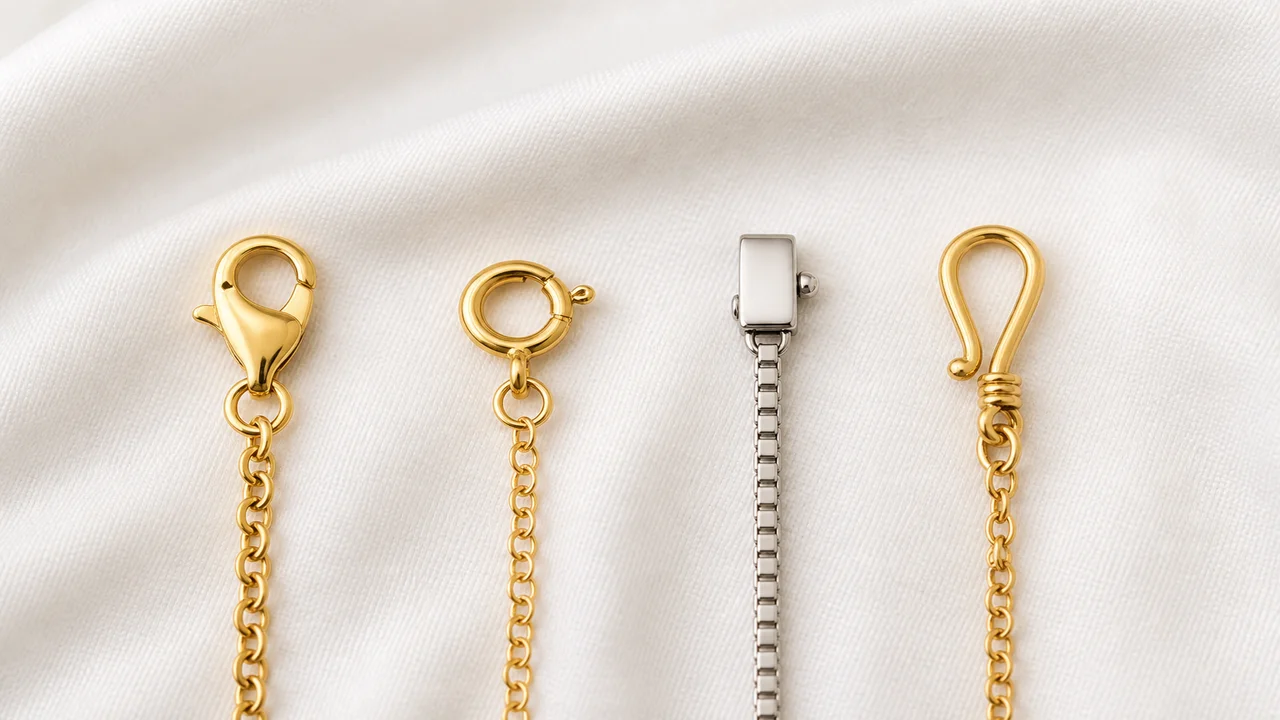
Clasp type can narrow how a necklace was designed and sometimes suggest a broad period, but it cannot supply an exact date. Closures overlap for decades, vary by country and price level, and are commonly repaired or replaced. Date the whole necklace, not just the clasp.
Scope: Jewelry Identifier offers photo-based identification clues. It is not certified appraisal, laboratory grading, metal testing, or authentication, and an image cannot prove clasp originality or necklace age.


Necklace Clasp Types at a Glance
| Clasp type | Mechanism | Dating usefulness |
|---|---|---|
| Hook and eye/S-hook | Curved hook enters ring or eye | Ancient form; construction matters more than type |
| Box clasp | Spring tongue slides into decorative box | Long use; style and safety features help |
| Barrel/screw clasp | Two threaded halves screw together | Common in many nineteenth-century and later forms |
| Spring ring | Round tube with spring-loaded opening | Long-lived from nineteenth century into present |
| Lobster clasp | Lever opens spring-loaded claw | Primarily modern/twentieth-century and later clue |
| Toggle | Bar passes through a ring | Very old principle; modern fashion use is widespread |
| Fishhook/pearl clasp | Hook or tongue secures in shaped body | Common on pearl and bead strands; details vary |
| Fold-over clasp | Hinged section folds and snaps over bar | Often twentieth-century, but examine full construction |
Hook, S-Hook, and Toggle Clasps
Hooks and toggles use simple mechanical principles found across very long periods. An S-hook can be hand-forged, cast, wire-formed, decorated, stamped, or newly made in a revival style. A toggle can belong to an ancient-inspired necklace or a recent mass-market chain.
Look at wire cross-section, tool marks, casting seams, wear, solder, attachment rings, and whether the clasp design belongs visually with the necklace. A bright machine-made jump ring connecting an apparently old hand-built clasp may indicate repair. That does not necessarily make the necklace unimportant, but it weakens clasp-based dating.
Box, Tongue, and Fishhook Clasps
Box clasps use a spring tongue inserted into a housing and can be plain, gem-set, filigree, enameled, or integrated into the necklace design. Variants have been made for centuries. Safety chains and side catches may add context, although they too can be added later.
Pearl and bead necklaces often use fishhook, tongue, or decorative box clasps. Examine stringing material, knotting, drill holes, end cups, and evidence of restringing. A vintage clasp can be reused on a newly restrung necklace, and old beads can receive a new clasp.
- Check whether the tongue snaps securely and whether metal fatigue is visible.
- Photograph the interior and exterior of the box for marks and repairs.
- Note separate safety devices, but do not use them as a single-date test.
- Compare wear on clasp, end links, and necklace body for consistency.
Barrel and Screw Clasps
A barrel clasp consists of threaded halves, sometimes disguised as a bead or decorative cylinder. Screw closures appear on chains, bead strands, pearls, and accessories. They are associated with many nineteenth-century and later pieces, but modern replacements remain readily available.
Inspect thread quality, seam placement, decoration, metal color, end attachments, and marks. Mismatched thread wear or a clasp color different from the chain can suggest replacement. Do not force a frozen threaded clasp; corrosion, cross-threading, or fragile stringing can cause damage.
Spring-Ring and Lobster Clasps
Spring rings use a small lever to retract a section of a circular tube. They have a long history extending from the nineteenth century and remain common, which makes “it has a spring ring” a weak date by itself. Size, construction, attachment, and markings provide better context.
Lobster or trigger clasps use a spring-loaded claw and are more strongly associated with twentieth-century and contemporary jewelry. However, a lobster clasp may be a recent replacement on an older chain. Modern findings also imitate earlier shapes, and manufacturers adopted mechanisms at different times.
Check whether the clasp and end ring carry matching fineness marks. A mark mismatch can mean mixed components, repair, or different legal marking practices—not automatically deception.
Clasp Timeline: Broad Clues, Not Exact Dates
| Broad period clue | Mechanisms encountered | Caution |
|---|---|---|
| Ancient through early modern | Ties, hooks, loops, pins, toggles | Simple forms are continuously revived |
| 18th–19th century contexts | Hooks, boxes, tongues, screws, early spring forms | Country and object type vary greatly |
| Late 19th–early 20th century | Spring rings, barrels, boxes, fishhooks, safety devices | Many remain in production today |
| Mid–late 20th century | Lobsters, fold-overs, modern boxes, magnetic precursors | Older mechanisms also continue |
| Contemporary | All historical forms plus magnets and engineered locks | Revival styling defeats type-only dating |
These are orientation ranges, not a certification system. Regional hallmark references and documented maker catalogs can be more precise.
How to Spot a Replacement Clasp
- Compare metal color, surface finish, patina, and wear between clasp and chain.
- Inspect jump rings for fresh cuts, uneven solder, tool marks, or a different wire gauge.
- Compare fineness and maker marks on both ends and on any pendant.
- Check whether the clasp size and strength suit the necklace’s weight.
- Look for missing original fittings, shortened chain ends, or added extenders.
- Review old photographs, receipts, and repair records if available.
A replacement can improve safe wear and still reduce originality for collectors. Record it rather than hiding it.
Photo Workflow for Clasp Identification
- Lay the full necklace flat and photograph its overall form.
- Take straight front and back photos of both clasp halves.
- Photograph the clasp open and closed without forcing it.
- Add macro views of springs, tongues, threads, safety chains, solder, and marks.
- Include end links, stringing, knots, jump rings, and the first several chain links.
- Record dimensions, necklace length, weight, and known repairs.
- Compare the entire object with documented examples and mark your date as a range.
For complete necklace matching, continue with find necklace by picture or estimate questions in how much is my necklace worth.
What a Photo Can and Cannot Prove
| Can support | Cannot prove |
|---|---|
| Clasp family and mechanism | Exact manufacturing date |
| Visible marks, solder, wear, and attachments | Whether every component is original |
| Possible replacement or repair clues | Metal purity or maker authenticity |
| Broad period-consistency questions | Unbroken provenance |
| Search vocabulary and comparable examples | Gem identity, certified appraisal, or value |
Date with converging evidence: clasp, chain, construction, marks, motif, stones, wear, maker records, and provenance. When value or authenticity matters, ask a vintage-jewelry specialist or qualified appraiser to inspect the necklace.
Frequently Asked Questions
Can a necklace clasp tell its exact age?
No. A clasp can support a broad date hypothesis, but styles overlap, remained in use, were reproduced, and are frequently replaced.
What is the oldest necklace clasp type?
Simple hooks, ties, pins, and loops are ancient forms, but a basic mechanism alone cannot date an individual necklace.
When did lobster clasps become common?
Lobster-style clasps are associated mainly with modern jewelry and became widespread during the twentieth century, with many later variations.
Does a spring-ring clasp mean a necklace is antique?
No. Spring rings have a long history and continue to be manufactured today. Construction, marks, chain, and provenance must also be assessed.
Can a photo authenticate a clasp or necklace?
No. Photos can document type, construction, marks, wear, and repairs, but cannot certify age, metal, originality, maker, stones, or value.