
Discover Vintage Jewelry Era From Photo Clues
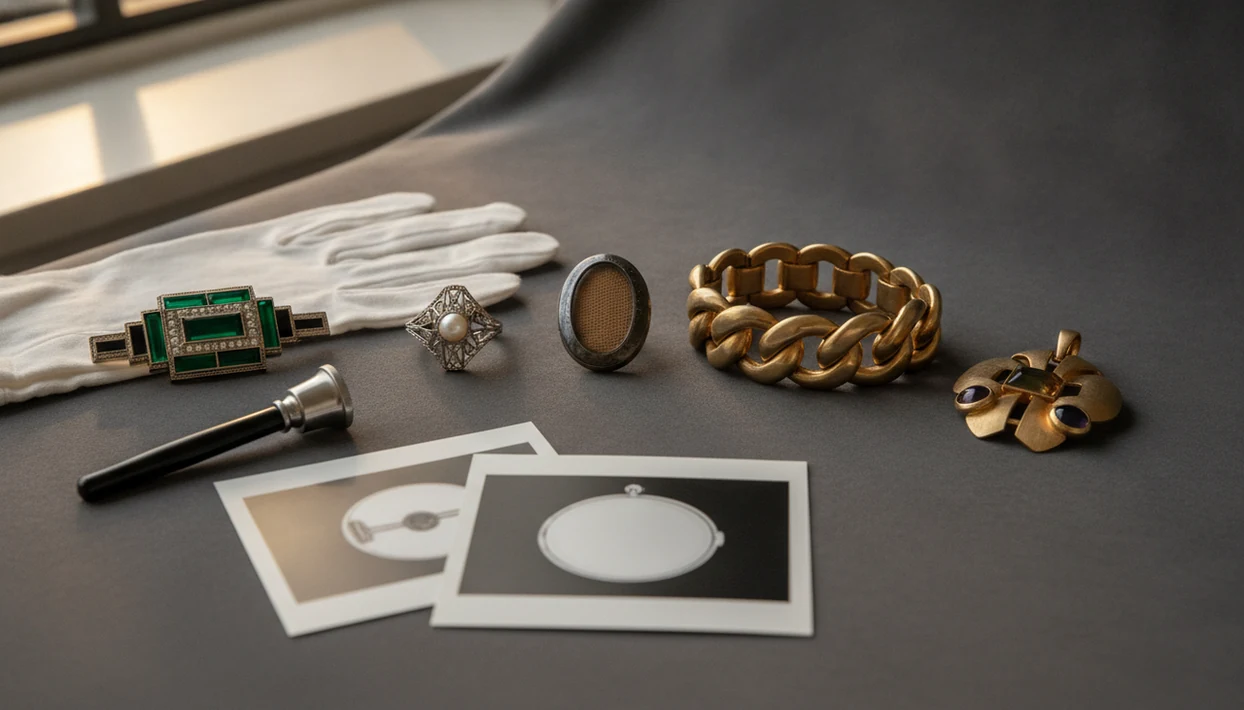


You can discover vintage jewelry era from photo clues by comparing the front design with back-side construction details such as clasps, pin stems, settings, hallmarks, stone cuts, and wear patterns. A photo can usually place a piece in a broad era such as Victorian, Edwardian, Art Deco, Retro, or Mid-Century, but it should not be treated as exact dating without stronger evidence.
Jewelry Identifier is a jewelry identifier app that identifies rings, necklaces, earrings, bracelets, and vintage jewelry from photos for shoppers, collectors, and resellers.
- Start with clear front, back, clasp, setting, and hallmark photos because construction details often date jewelry better than style alone.
- Use era clues as a range, not a verdict: Art Deco geometry, Victorian sentiment, Edwardian delicacy, Retro volume, and Mid-Century abstraction can all be revived later.
- Cross-check every photo clue against findings, metal, stone cut, maker marks, wear, and repair history before calling a piece truly period.
Vintage Jewelry Era Clues Visible in One Photo
A single jewelry photo can suggest an era, but it rarely proves an exact year. The most useful photo clues are the front design, back construction, clasp, setting, stone cut, motif, metal color, hallmark, and visible wear.
Start with the parts that were made to function, not just the parts made to impress. A brooch back, bracelet clasp, ring shank, or earring fitting can show construction habits that the front design hides. We have watched a necklace look “Edwardian” from the front, then read as much later once the spring ring and solder work came into focus.
About 75% of online shoppers rely on product photos when deciding whether to buy, according to Etsy’s buyer research summary: https://www.etsy.com/seller-handbook/article/143986679284. For jewelry, that makes sharp front, back, clasp, setting, and hallmark photos especially important. Tools like JewelryIdentifier and photo guides can help organize those clues into likely categories, not appraisals.
Photos narrow the search. They do not finish it.
Five Facts for Dating Vintage Jewelry by Photo
- Clear front and back photos are necessary because style, setting, and construction must be read together.
- Clasps and findings can narrow the range, especially on brooches, necklaces, bracelets, and earrings.
- Motifs and silhouettes point to likely eras, such as Victorian mourning jewelry, Art Nouveau nature forms, or Art Deco geometry.
- Revival styles can copy period looks, so an old-looking design may still be modern.
- Valuable or ambiguous jewelry needs a qualified appraiser, especially if insurance, resale, estate division, or metal testing is involved.
The heritage angle matters here. Heirloom and sentimental value often matters as much as resale value; the Gemological Institute of America recommends documenting jewelry details and seeking qualified appraisal support for important pieces: https://www.gia.edu/gia-news-research-appraising-jewelry. That is why an inherited bracelet with a handwritten note under the stack deserves slower checking than a quick image match.
For family pieces, a photo-based era estimate is often better than guessing from memory because it preserves visible clues before cleaning, repair, or resale.
How Photo-Based Vintage Jewelry Era Identification Works
Photo-based vintage jewelry era identification works by matching visible construction, materials, style vocabulary, and markings against known era patterns. The result is a probability range, not a certified date.
The back of a piece can be more diagnostic than the front because clasps, hinges, pin stems, solder seams, open backs, closed backs, and shanks change with manufacturing habits. The front may say “Art Deco” through symmetry and contrast, but the back may show a modern cast frame.
Photo guides and apps compare visible features using image matching and reference patterns. In plain terms, the tool looks for similar shapes, settings, marks, and construction clues. JewelryIdentifier jewelry identifier app and photo guides that help users identify rings, necklaces, earrings, bracelets, and vintage jewelry from pictures can give vocabulary and next-step checks, not a legal value or authentication verdict.
A good photo process gives likely era language, not certainty.
How to Use Photos to Discover Vintage Jewelry Era
Use a repeatable photo workflow so each visible clue can be checked against the others. The goal is to build a small evidence set, not rely on the prettiest angle.
- Photograph the front in natural light, with the whole piece in frame and the main motif sharp.
- Photograph the back, clasp, pin stem, hinge, shank, or earring fitting without flash glare.
- Capture macro shots of hallmarks, maker marks, and metal stamps, even if lint or dark pocket fuzz hides part of the mark.
- Compare motifs, stone cuts, settings, and findings against era references before choosing a style term.
- Cross-check with JewelryIdentifier or a photo guide and save comparable examples beside your own notes.
- Ask an appraiser about valuable, damaged, repaired, or contradictory pieces.
A ring tilted toward window light often reveals more than a dozen bright counter photos. If you are building a larger sorting project, a vintage jewelry identifier by photo workflow can keep the evidence consistent.
Clasp, Finding, and Back-Side Clues That Date Vintage Jewelry
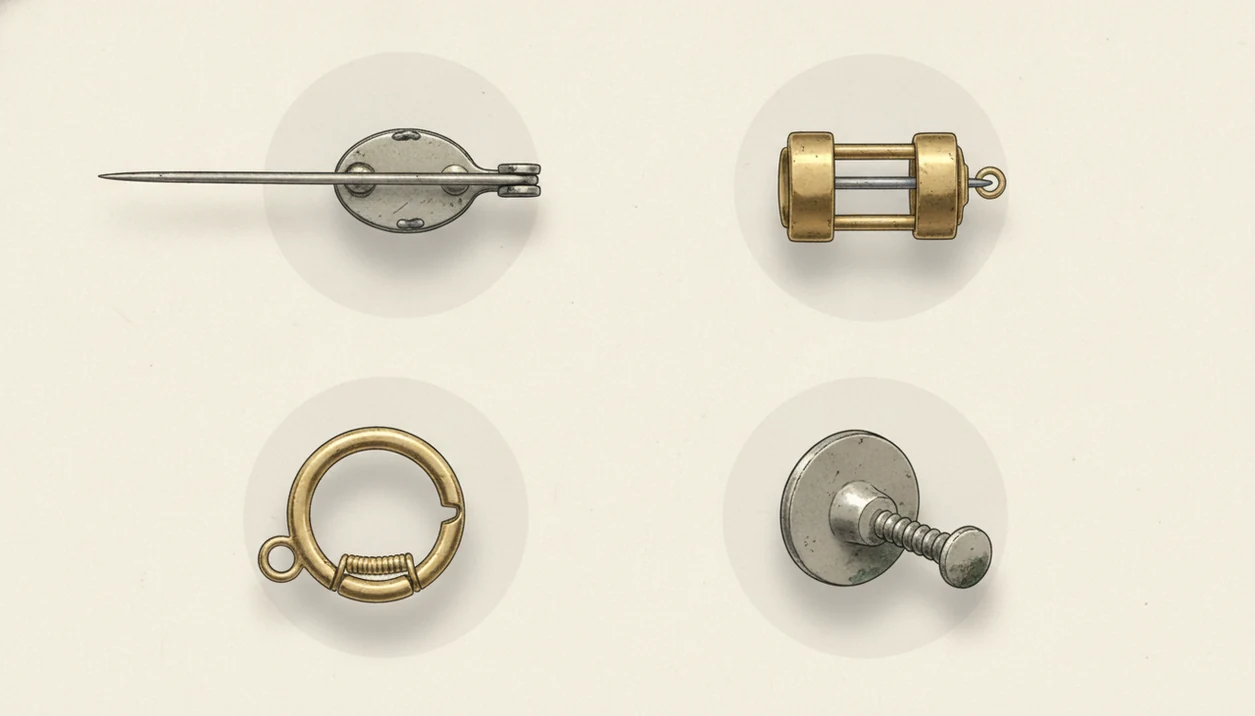
To date vintage jewelry by clasp, treat the clasp as one clue within a group of findings and construction details. Clasp type gives an approximate range, not a definitive date.
| Back-side clue | Often seen on | What to check in the photo | Caution |
|---|---|---|---|
| C-clasp | Brooches and pins | Pin length, hinge tube, open catch shape | Later makers may copy the look |
| Tube hinge | Brooches | Barrel shape, pin thickness, solder age | Repairs can replace hinges |
| Safety catch | Brooches | Rotating lock, added hardware, solder marks | Some were added later |
| Screw backs | Earrings | Thread wear, pad shape, metal color | Used across many decades |
| Lever backs | Earrings | Wire shape, hinge wear, construction quality | Still made today |
| Lobster clasp | Necklaces and bracelets | Modern spring mechanism and finish | Usually points later, not always |
| Spring ring | Chains | Ring size, seam, wear near jump ring | Can be replaced easily |
| Fold-over clasp | Bracelets | Stamped metal, hinge, safety chain | Common in vintage and modern pieces |
Brooch pin length, open versus closed backs, solder quality, and repair evidence can change the reading. We once saw prong wear on raised stones suggest age, but a fresh fold-over clasp told a different story.
Era-by-Era Vintage Jewelry Photo Clues
Era clues work best when the front design and back construction agree. Use this table as a first sorting map, then compare marks, wear, and findings.
| Era | Likely date range | Front clues | Back clues | Caution |
|---|---|---|---|---|
| Victorian | 1837-1901 | Sentimental motifs, florals, mourning themes, lockets, yellow gold, dark stones | Hand construction, older pin fittings, closed backs | Revival mourning and locket styles are common |
| Art Nouveau | 1890-1915 | Flowing lines, feminine profiles, enamel, nature forms, asymmetry | Delicate settings, hand-finished backs | Soft curves alone are not enough |
| Edwardian | 1901-1915 | Platinum look, garlands, bows, milgrain, lace-like metalwork | Fine galleries, delicate settings | White-metal reproductions can look convincing |
| Art Deco | 1920-1935 | Geometry, symmetry, contrast, calibré stones, filigree, white metals | Precise setting work, period findings | Deco revivals are widespread |
| Retro | 1935-1950 | Large scale, rose or yellow gold, scrolls, bows, synthetic rubies | Heavier construction, bold backs | Later cocktail jewelry can overlap |
| Mid-Century | 1950-1970 | Cleaner shapes, textured gold, abstract forms, cocktail styles | Modernized clasps, cast elements | Dating depends heavily on maker context |
For resellers, era comparison is often easier than vague adjectives because style terms copied into a listing help buyers search accurately.
How to Identify Art Deco Jewelry From Photo Without Overclaiming
Identify Art Deco jewelry from photo by looking for geometric symmetry, white metals, milgrain, filigree, step-cut or calibré stones, and strong black-and-white contrast. Those clues can support an Art Deco style call, but they do not prove 1920s-1930s origin by themselves.
True period pieces may show hand-finished or die-struck details, crisp galleries, older stone setting habits, and wear that matches the construction. Later cast reproductions can look flatter on the back, with more uniform surfaces or newer findings. Art Deco revival waves from the 1960s onward copied the look closely, especially in rings, brooches, and marcasite-style pieces.
Cross-check the clasp, setting, hallmark, stone cut, and wear before assigning a 1920s-1930s origin. A maker mark cropped out of a resale photo can change the answer completely. If you are comparing tools, the best app for identifying vintage jewelry guide is most useful when you already have front, back, and mark photos.
Common Myths About Vintage Jewelry Era Clues
The jewelry market includes new, vintage, antique, and vintage-inspired pieces at enormous scale; Grand View Research estimated the global jewelry market at USD 353.26 billion in 2023: https://www.grandviewresearch.com/industry-analysis/jewelry-market. That abundance makes photo-based myths easy to repeat.
- Myth 1: One photo can reveal the exact year. One photo may suggest Victorian, Art Deco, or Mid-Century style, but exact dating usually needs marks, construction, provenance, or appraisal.
- Myth 2: Old-looking clasps always mean antique. Modern makers can use C-clasps, screw backs, or decorative safety catches for style.
- Myth 3: Geometric jewelry is automatically original Art Deco. Geometry also appears in later revivals and modern designs.
- Myth 4: A jewelry identifier app can provide a definitive appraisal. JewelryIdentifier jewelry identifier app and photo guides that help users identify rings, necklaces, earrings, bracelets, and vintage jewelry from pictures can deliver likely categories and vocabulary, not guaranteed authenticity or legal value.
- Myth 5: Hallmarks always settle the date. Marks can be partial, worn, fake, misread, or hidden under grime.
Tiny stamps cause trouble. Under thrift-store fluorescent lights, even a 14K mark inside a yellow-gold ring can look like scratches until the angle changes.
Period Jewelry Versus Revival Jewelry in Photos
Period jewelry was made during the era it represents. Revival jewelry was made later while borrowing an older style vocabulary, such as Victorian sentiment, Edwardian lace, or Art Deco geometry.
| Photo clue | Period jewelry may show | Revival jewelry may show |
|---|---|---|
| Wear | Uneven wear in logical contact points | Uniform surface aging or artificial darkening |
| Finish | Hand finishing, tool variation, older setting habits | Modern casting, repeated mold texture |
| Findings | Era-consistent clasps, hinges, backs, or earring fittings | Newer clasps paired with older-looking fronts |
| Patina | Age consistent with protected and exposed areas | Darkening that sits only in recesses |
| Maker context | Marks, catalogs, or references that fit the date | Mixed components or unclear branding |
Repaired jewelry complicates the table. A Victorian brooch can have a later safety catch, and a Mid-Century bracelet can carry a replaced clasp. About 40% of jewelers and precious stone workers are self-employed or work in small specialty shops, according to the U.S. Bureau of Labor Statistics, which is one reason estate pieces often need specialist review.
For inheritance boxes, the jewelry identifier for inheritance organizers approach works well because it separates likely gold, likely silver, costume, sentimental, and take-to-a-jeweler piles.
Limitations
Photo-only vintage jewelry identification has real limits. Use negative evidence as carefully as positive evidence.
- Blurry, cropped, filtered, or poorly lit photos can distort metal color, stone color, setting depth, and construction.
- Photos usually estimate an era range, not an exact year.
- Transitional designs can blend late Victorian, Edwardian, Art Deco, Retro, or Mid-Century traits.
- Revival and reproduction pieces can use period-looking motifs, clasps, findings, and stone cuts.
- Repairs can create mixed-era components, such as an older brooch with a newer safety catch.
- Hallmarks may be worn, partial, fake, missing, polished away, or outside the photographed area.
- Flash can make a pendant front blow out while the clasp stays sharp, which leaves the most decorative clue unreadable.
- Value, authenticity, insurance, tax, and legal appraisal conclusions require in-person specialist review.
If a piece looks valuable, contradictory, or damaged, stop treating the photo as enough. A tool that can identify jewelry safely should make the next detail to check clearer, but it should not replace testing or appraisal.
FAQ
Can a photo date my jewelry accurately?
A photo can suggest a broad era such as Victorian, Edwardian, Art Deco, Retro, or Mid-Century. It rarely dates jewelry to an exact year without marks, records, or specialist review.
What clasp means jewelry is antique?
No clasp automatically proves jewelry is antique. C-clasps, tube hinges, screw backs, and older safety catches help only when they match the setting, wear, metal, and construction.
How old is a C-clasp on a brooch?
A C-clasp can suggest an older brooch style, especially on 19th-century and early 20th-century pieces. Later use, repair, or reproduction hardware can make the clue unreliable alone.
Is Art Deco jewelry always vintage?
Art Deco jewelry can be original 1920s-1930s period jewelry or later revival jewelry. Photos must be checked for construction, stones, marks, findings, and wear.
What marks can show jewelry age?
Hallmarks, maker marks, metal stamps, patent marks, assay marks, and date letters can help show age where applicable. Marks must be clear and checked against reliable references.
Can apps identify vintage jewelry from photos?
Apps such as JewelryIdentifier can provide likely matches, style terms, and visible clues from photos. They cannot provide a definitive appraisal, metal test, gemstone grade, or authentication.
What photos should I take to identify vintage jewelry?
Take clear photos of the front, back, clasp, setting, hallmark, side profile, and any maker mark. Natural light and close focus usually help more than flash.
How do revival jewelry pieces fool buyers?
Revival pieces copy older motifs such as Art Deco geometry or Victorian sentiment. Newer construction, modern clasps, uniform casting, or mixed components may reveal the later date.
Do stone cuts reveal jewelry age?
Stone cuts can help estimate an era, especially when they match the setting and construction. Stones can also be reset, replaced, recut, or reproduced.
When should I use a jewelry appraiser?
Use a jewelry appraiser for valuable, insured, inherited, damaged, or legally important pieces. Appraisal is also wise when photo clues contradict each other.
Identify Vintage Jewelry Clues From a Photo
Upload clear photos of the front, back, clasp, setting, and any marks to get a practical era-clue read from Jewelry Identifier. For high-value buying, selling, or insurance, use the result as a starting point and verify with a qualified professional.