
Gemstone Identifier by Photo: Color, Cut, Setting, and Visual Clues
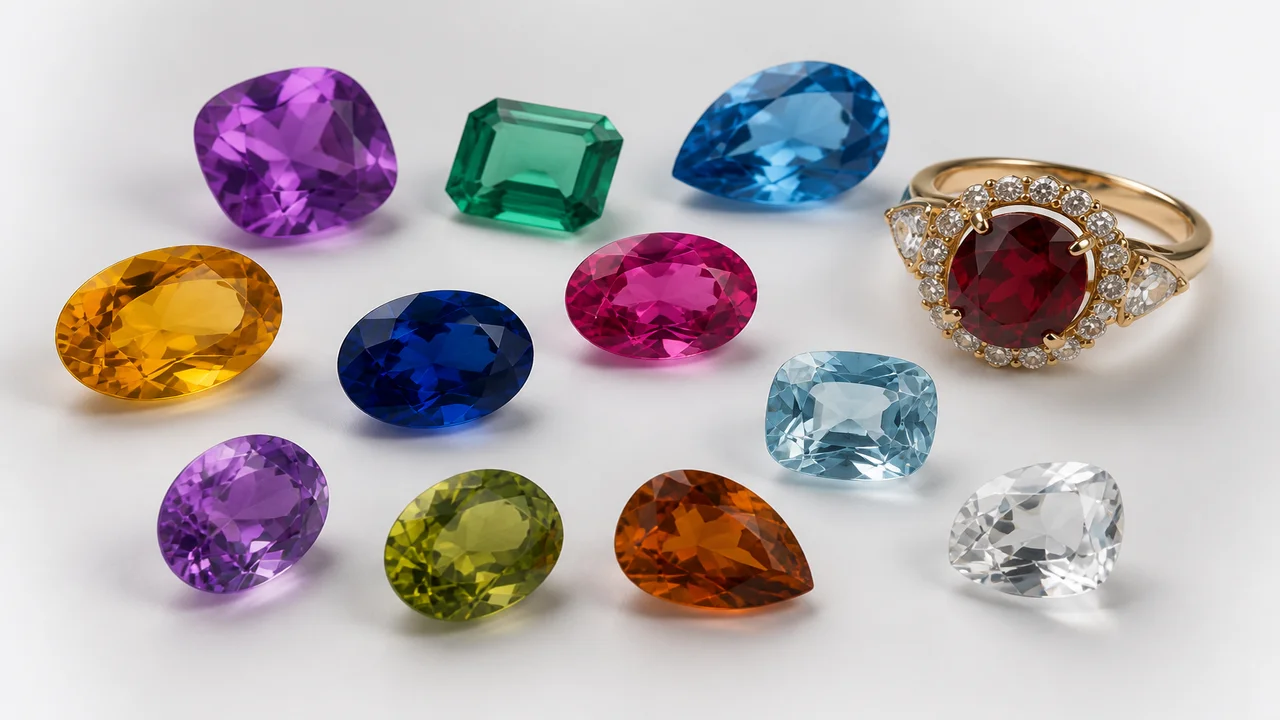
A gemstone identifier by photo can organize visible observations: hue, tone, saturation, transparency, apparent cut, setting, inclusions, surface wear, and jewelry context. It cannot establish gemstone species because different natural, synthetic, treated, assembled, and imitation materials can look alike.
Scope: Jewelry Identifier is not a certified appraisal or gem laboratory. Photo/app output is not proof of species, natural origin, treatment, geographic origin, grade, or value.


What a Gemstone Photo Can Identify
| Visible clue | Useful description | Why it is not proof |
|---|---|---|
| Color | Hue, light/dark tone, weak/strong saturation | Many species overlap; camera processing shifts color |
| Transparency | Transparent, translucent, opaque | Multiple materials share each category |
| Cut | Oval brilliant, step cut, cabochon, bead, carving | Cut describes form, not composition |
| Visible features | Color zoning, bubbles, needles, chips, crazing | Focus and reflections can imitate features |
| Setting/context | Ring, pendant, period-style mount, prong type | A stone may be replaced or remounted |
Use Color as a Starting Clue, Not a Name
Describe color before naming candidates. “Medium-dark, strongly saturated bluish green” is more useful than immediately declaring emerald. Green stones can include emerald, tourmaline, peridot, garnet, sapphire, jade, glass, and synthetics. Red can include ruby, spinel, garnet, tourmaline, glass, and many treated materials.
Photograph beside a neutral gray or white reference under indirect daylight and a second neutral artificial light. Disable filters, portrait mode, and automatic enhancements when possible. Keep the original files because screenshots and social platforms alter color.
Pleochroism, fluorescence, and color change can be important, but casual photos do not standardize observation. Record the behavior as a clue and let a gemologist interpret it.
Cut, Shape, and Surface Clues
Separate shape from cutting style. Oval, round, pear, rectangular, cushion, and freeform describe outlines. Brilliant, step, mixed, rose cut, cabochon, bead, cameo, and carving describe how the material was fashioned.
- Facet-junction wear may suggest a softer material, long use, or poor polish, but blur can mimic rounded edges.
- Bubbles may support glass as a candidate, yet dust, reflections, and inclusions can be mistaken for bubbles.
- A star or cat’s-eye effect requires controlled moving light and may be natural, synthetic, or induced.
- Doublets and triplets may show joins at the side, but settings often hide them.
- Foil backs and closed settings can intensify color and conceal the stone’s pavilion.
Do not remove an unknown or fragile stone merely for photography. A jeweler should evaluate removal risk.
How the Setting and Jewelry Style Help
The setting provides context, not identity. A closed-back Georgian-style mount may suggest certain research paths; a modern calibrated channel setting suggests others. But stones are routinely replaced, reset, coated, and assembled into older jewelry.
Photograph prongs, bezel, foil or backing, underside openings, drill holes, glue, surrounding stones, and hallmarks. Note whether wear on the stone is consistent with wear on the setting. Use vintage jewelry identifier for broader period clues while keeping exact dates conditional.
A high-quality setting may justify professional review, but it does not guarantee the center stone is valuable. Costume designers also used sophisticated construction.
Photo Workflow for Gemstone Candidates
- Clean only when you know a method is safe; porous, fracture-filled, dyed, coated, and assembled stones can be damaged.
- Take face-up, profile, back, and three-quarter images under diffused neutral light.
- Add macro images of inclusions, surface wear, drill holes, joins, foil, and damage.
- Include a millimeter ruler and record whether measurements are exact or approximate.
- Photograph all metal marks and the complete jewelry item for context.
- List several candidates and write what test would separate them.
- Use a gemologist or laboratory before making material, treatment, origin, or value claims.
What Physical Tests Add
Gemologists may use refractive index, specific gravity, magnification, polariscope, dichroscope, spectroscopy, fluorescence, electrical or thermal behavior, and advanced laboratory instrumentation. The appropriate sequence depends on whether a stone is loose or mounted and whether it may be fragile.
| Question | Photo status | Verification route |
|---|---|---|
| What species is it? | Candidate list only | Gemological testing |
| Natural or synthetic? | Usually not resolvable | Microscopy and possibly advanced lab work |
| Has it been treated? | Some clues may be visible | Specialist/laboratory analysis |
| Where was it mined? | Cannot be established | Advanced origin report where possible |
| What is it worth? | Cannot be certified | Identification followed by appraisal |
Common Photo Identification Mistakes
- Naming a gem from color alone.
- Assuming visible inclusions prove natural origin.
- Calling every colorless brilliant stone diamond.
- Ignoring synthetic, treated, coated, glass-filled, doublet, and triplet possibilities.
- Using an old setting to assign the stone the same age.
- Estimating carat weight from face-up size without depth or density.
- Turning a visual match into a certified value.
For colorless stones in ring settings, diamond identifier by photo focuses on shape and design, while the same authenticity limits remain.
What Photo Identification Cannot Prove
A photo cannot prove gem species, natural versus synthetic origin, treatment, geographic source, clarity grade, precise color grade, exact carat weight, or monetary value. It can miss filled fractures, diffusion, coatings, composite construction, and damage hidden by the setting.
Use Jewelry Identifier to create a neutral observation sheet and candidate list. For buying, selling, insurance, inheritance, or repairs involving an important stone, obtain professional testing and, where appropriate, a lab report and separate appraisal.
Frequently Asked Questions
Can an app identify a gemstone from a photo?
An app can suggest visual categories and possible candidates, but it cannot confirm gemstone species, natural origin, synthesis, treatment, or geographic origin.
Does gemstone color identify the stone?
No. Many gem species overlap in color, and lighting, white balance, treatments, coatings, and glass can create similar appearances.
What photos help identify a gemstone?
Use face-up, profile, back, setting, hallmark, ruler, and neutral-light photos, plus separate images in transmitted light when safe.
Can a picture show whether a gemstone is natural?
No. Natural, synthetic, treated, assembled, and imitation stones can appear alike in standard photos.
When is lab testing needed?
Use a gemologist or laboratory when identity, treatment, origin, value, insurance, purchase, or resale claims matter.