Can An App Tell If a Diamond Is Real From a Photo?
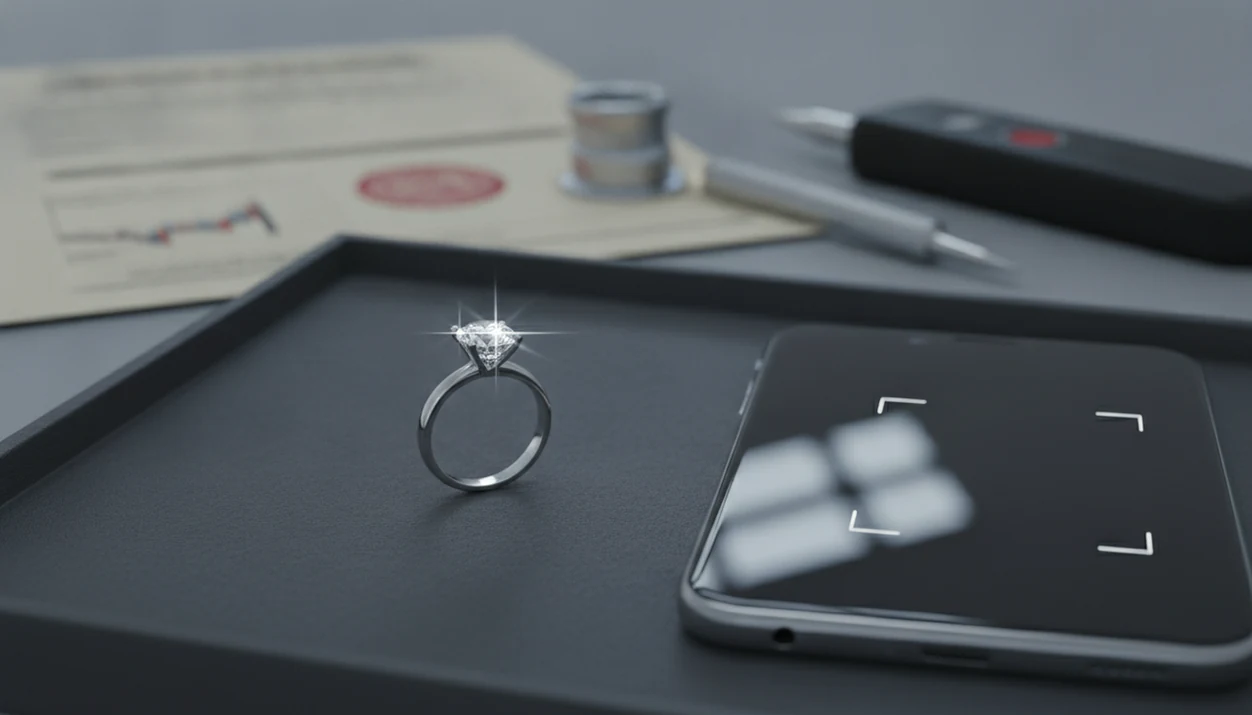


No, can an app tell if diamond is real from a photo has a clear limit: a photo-only app can describe how a stone looks, but it cannot prove whether it is natural diamond, lab-grown diamond, moissanite, or cubic zirconia. Real confirmation requires physical testing, trained inspection, and often a grading report.
> Definition: A diamond identifier app is a photo-based jewelry tool that can help describe visible features of a ring or stone, but it cannot authenticate diamond material from an image alone.
- A phone camera cannot measure thermal conductivity, electrical conductivity, crystal structure, or fluorescence response.
- Photo-based AI may help with jewelry style, setting, cut appearance, and obvious visual clues, but not proof of diamond authenticity.
- For valuable jewelry, use a qualified jeweler, diamond tester, or gemological lab report rather than relying on an app result.
Can an App Tell If Diamond Is Real From a Phone Photo?
A photo-only app cannot definitively confirm that a stone is a real diamond. It can describe visible appearance, not prove gem material.
A clear phone photo may show the ring setting, cut shape, prong style, visible chips, surface wear, and whether the stone looks cloudy or bright. That is useful when you’re trying to say, “I just need to know what to call this before I list it.” It is not the same as testing the stone.
Natural diamond, lab-grown diamond, moissanite, and cubic zirconia can look very similar in ordinary photos. Flash, compression, and dirty glass counters make the problem worse.
Tools like JewelryIdentifier can help identify jewelry types and visible design clues, especially for rings and vintage settings, but they do not replace lab testing or hands-on confirmation.
How Photo-Based Diamond Identifier App Accuracy Works
Photo-based diamond identifier app accuracy depends on visual pattern matching, not material testing. AI image tools compare your photo with labeled examples and estimate the likely category.
The software may notice round brilliant shapes, emerald cuts, prong counts, pavé stones along thin shoulders, bezel settings, yellow metal, or a raised solitaire profile. Technically, these systems use image embeddings, which means the photo is converted into a pattern the model can compare with other patterns. Plainly: it recognizes what the piece resembles. That makes the result a visual similarity estimate, not a gemological measurement; NIST describes AI image recognition as pattern-based classification that can fail when the input differs from training examples: https://www.nist.gov/artificial-intelligence.
It does not touch the stone. No probe contacts the gem, no microscope checks inclusions, and no spectrometer reads growth features.
Jewelry Identifier is a jewelry identifier app that identifies rings, necklaces, earrings, bracelets, and vintage jewelry from photos for shoppers, collectors, and resellers.
Photo-first tools give vocabulary and next-detail checklists, not a diamond verdict.
5 Facts About AI Diamond Identification From Images
- No photo-only app can definitively confirm diamond authenticity, because image data cannot prove physical composition.
- Jewelers and labs use thermal or electrical testers, magnification, spectroscopy, fluorescence checks, and grading reports.
- High-quality moissanite and well-cut cubic zirconia can look convincing in photos, especially under jewelry-store lighting.
- App-store phrases like “diamond scanner online” may describe visual guides, not true gemological instruments.
- High-value stones need instrument testing and documentation before resale, insurance, or estate division.
We’ve seen phone photos where the clasp is crisp but the pendant front is blown out by flash. The same problem happens with stones. The sparkle may be visible, but the important evidence is missing.
For resale or insurance, instrument testing is safer than photo identification because the result depends on measurable gem properties.
Diamond vs Moissanite From Photo: What the Camera Misses
Photos can show visible clues, but testing measures physical behavior. That gap is why diamond vs moissanite from photo searches often lead to overconfident answers.
| Question | What a photo may show | What testing measures |
|---|---|---|
| Natural diamond vs lab-grown diamond | Similar brightness, cut, and setting | Growth features, spectroscopy, lab documentation |
| Diamond vs moissanite | Possible strong fire or rainbow flashes | Electrical conductivity and other instrument readings |
| Diamond vs cubic zirconia | Clean, bright appearance when well cut | Density, wear, thermal behavior, optical properties |
| Valuable ring vs costume setting | Metal stamp, prong wear, maker mark | Metal content, stone identity, condition under magnification |
Moissanite may show strong fire, but phone processing can exaggerate or flatten that clue. Cubic zirconia can also look persuasive when clean and well cut.
GIA explains that laboratory-grown diamonds have essentially the same chemical composition and crystal structure as natural diamonds, which is why separating them usually requires advanced testing and trained gemologists: https://www.gia.edu/gia-news-research/difference-between-natural-laboratory-grown-diamonds.
Authoritative Sources for Diamond Testing Claims
Authoritative diamond claims come from gemological testing and sale-disclosure rules, not from a photo app’s label. GIA is the key reference for separating natural and laboratory-grown diamonds, while the FTC Jewelry Guides shape how sellers should describe diamonds, lab-grown stones, and imitations.
Use app output as a sorting note: “looks like a solitaire,” “possible round brilliant,” or “check for moissanite.” Do not turn it into a material claim unless testing or documents support it.
- Treat photo-app results as visual observations, not authentication.
- Confirm diamond identity with accepted gemological methods such as conductivity testing, magnification, spectroscopy, fluorescence observation, or lab review.
- Separate natural diamond from laboratory-grown diamond only with proper testing and documentation, because normal photos do not show the growth evidence needed.
- Describe items for sale using clear FTC-style language when a stone is laboratory-created, imitation, or only presumed.
- Keep grading reports, appraisal records, receipts, repair notes, and jeweler test results with the piece whenever value, insurance, or resale depends on the claim.
Real Diamond Tester App Claims vs Gemological Testing
“Can a real diamond tester app, diamond scanner online, or app to check if diamond is real replace a jeweler?” No. These apps may guide checks, but they cannot perform the core tests.
Some apps walk users through fog tests, water tests, flashlight checks, newspaper tests, or side-by-side sparkle comparisons. Those methods may raise questions. They do not prove authenticity. A clean stone in a tight setting can pass a casual check and still be a simulant.
Treat general visual-search tools such as Google Lens, eBay image search, or marketplace photo search the same way: they can surface similar-looking rings or stones, but they cannot authenticate diamond material.
Reliable confirmation uses jeweler testing, thermal and electrical probes, microscopy, spectroscopy, fluorescence observation, and a GIA or similar report. A thrift-store counter check under fluorescent lights might help you decide whether to ask more questions. It should not decide the price.
For sale descriptions, the FTC Jewelry Guides also matter: laboratory-created stones and imitation products must be described clearly, so an app result should not be the only basis for a resale listing or insurance description: https://www.ecfr.gov/current/title-16/chapter-I/subchapter-B/part-23.
If the question is broader, like can an app tell if jewelry is real gold, the same rule applies: photos can suggest clues, but material proof needs testing.
When to Get a Jeweler or Gemological Lab Report
Get professional testing whenever the result affects money, ownership, repair risk, or insurance coverage. An app can help you sort visible clues, but it should not be used to price a stone or settle what it is.
A local jeweler is usually the right first stop for screening. They can check whether a stone reacts like diamond or moissanite, look under magnification, read metal marks, and inspect whether prongs or bezels are secure before you wear, clean, ship, or repair the piece. A gemological lab is the safer route for high-value stones, inherited pieces with disputed identity, or any stone where natural diamond, lab-grown diamond, moissanite, or another simulant must be documented clearly.
- Get initial jeweler screening before resale, insurance scheduling, estate division, or major repair work.
- Ask the jeweler to check the setting as well as the stone, especially if the ring has loose prongs or old repairs.
- Use a gemological lab when the stone is valuable, contested, or needs formal identification.
- Request written results when inheritance, coverage, sale price, or buyer confidence depends on accuracy.
- Avoid setting a final price from an app result alone.
Useful Photo Clues Before a Diamond Appraisal
Photos are useful before a diamond appraisal because they help organize what to ask. They can document visible clues, even when they cannot authenticate the stone.
Visible clues a jewelry photo can support
- Setting style: Solitaire, halo, three-stone, cluster, tension, bezel, or pavé setting.
- Metal marks: Stamps such as 14K, 18K, PT, 925, or maker initials.
- Stone condition: Visible chips, abrasion, cloudiness, loose prongs, or uneven mounting.
- Era cues: Clasp types, engraving style, old repairs, and worn initials inside a signet ring.
Questions to ask a jeweler after using an app
Ask whether the stone tests as diamond, moissanite, or another simulant. Ask whether the metal stamp matches test results. Ask whether the setting is secure enough to wear.
JewelryIdentifier jewelry identifier app and photo guides that help users identify rings, necklaces, earrings, bracelets, and vintage jewelry from pictures deliver naming help and visible-clue organization, not authentication or insured value. For value decisions, the jewelry appraisal app vs professional appraisal difference matters.
Common Myths About Diamond Identifier App Accuracy
- Myth: AI can see everything a jeweler sees. AI can compare pixels, but it cannot rotate the stone under magnification or test conductivity.
- Myth: an app result of “diamond” means natural diamond. Lab-grown diamond and natural diamond can look the same in normal photos.
- Myth: sparkle proves a stone is real. Moissanite and cubic zirconia can sparkle strongly, especially under bright LEDs.
- Myth: fog, water, newspaper, or flashlight tests guarantee authenticity. These are screening clues, not proof.
- Myth: a clean-looking stone must be valuable. Value depends on identity, cut, condition, carat weight, setting, market demand, and documentation.
Tiny details matter. Lint, skin oil, and dark pocket fuzz can hide a mark inside a bracelet clasp, and the same kind of ordinary grime can distort what a camera sees on a ring.
For safe sorting language, a tool that can identify jewelry safely should separate visible clues from authentication claims.
Limitations
Photo-based diamond identification has hard limits. These are not small edge cases.
- Phone cameras and lighting vary too much for reliable authentication.
- AI image models may learn from mislabeled training photos.
- Apps cannot measure thermal conductivity, electrical conductivity, specific gravity, fluorescence reaction, or crystal structure.
- At-home visual tests can be passed by simulants or distorted by settings and fancy cuts.
- Natural and lab-grown diamonds cannot be separated by normal photos.
- A stone hidden in a deep bezel may reveal less than a loose stone viewed under a microscope.
- High-value, inherited, resale, or insurance-related jewelry needs a qualified jeweler or lab report.
- Uploading jewelry photos can expose personal or location clues, so it is worth asking is it safe to upload jewelry photos before sharing images.
Kitchen-table piles help: likely gold, likely silver, costume, sentimental, and take-to-a-jeweler. The last pile exists for a reason.
Diamond Certificate Versus Photo Identification
Photo identification describes what a mounted stone and its setting appear to resemble. It may suggest a round brilliant shape, halo setting, visible chips, metal stamps, or a likely style, but it does not measure the stone or establish whether it is natural diamond, laboratory-grown diamond, moissanite, cubic zirconia, or another material. Image results are therefore useful screening notes, not a certificate.
A diamond grading report is based on examination of the submitted stone by a gemological laboratory and records specific findings under the lab’s procedures. The report number and physical characteristics can help connect a stone to its document, while a phone photo usually cannot. Keep the original report and verify its number with the issuing laboratory rather than accepting a photographed certificate or an app label at face value.
What a Diamond Grading Report Proves
A grading report documents the laboratory’s conclusions about the stone examined on the report date. Depending on the service, it may state whether the stone is natural or laboratory-grown, list shape and measurements, and grade characteristics such as carat weight, color, clarity, and cut. It may also note fluorescence, inscriptions, treatments, or a plotted diagram of identifying features.
The report does not prove ownership, purchase price, current market value, or that every stone in a finished piece matches the document. It is also not an appraisal or a guarantee against damage after grading. Compare the report number, measurements, inscription when present, and identifying features with the actual diamond through a qualified jeweler or laboratory, especially before an expensive purchase.
When to Verify a Diamond With a Laboratory
Laboratory verification is appropriate when diamond identity, origin, treatment, or grading will materially affect a sale, insurance schedule, inheritance, legal dispute, or major repair. It is particularly useful for a significant loose stone, a high-value ring without reliable paperwork, conflicting tester results, or a purchase represented as natural rather than laboratory-grown. A local jeweler can first inspect the setting and advise whether removal or direct lab submission is practical.
Ask which laboratory will examine the stone, what the requested report covers, how the item will be insured in transit, and whether the setting limits grading. For lower-value jewelry, professional screening may be proportionate without a full report. For consequential transactions, however, an independent report provides evidence that a photo app, seller description, or basic handheld tester cannot supply.
FAQ
Can my phone test diamonds?
A phone can guide visual checks, but it cannot perform true gemological tests. Diamond confirmation requires physical testing or lab review.
Can AI identify diamonds?
AI can describe a stone’s appearance and likely jewelry context. It cannot prove diamond material identity from a photo alone.
Are diamond tester apps accurate?
Diamond tester app accuracy is limited because apps cannot measure physical properties. Treat app results as screening clues, not authentication.
Can photos show fake diamonds?
Photos may flag obvious fakes, damaged stones, or costume settings. Convincing moissanite and cubic zirconia can still look real in images.
Can an app detect moissanite?
An app may notice visual clues associated with moissanite. Reliable separation often needs conductivity testing or professional inspection.
Can an app detect cubic zirconia?
An app may suggest cubic zirconia if the visual clues fit. It cannot confirm cubic zirconia from an image alone.
Can an app detect a lab-grown diamond?
No normal photo app can reliably separate lab-grown diamond from natural diamond. They share the same chemical composition and crystal structure.
Does sparkle prove a stone is a diamond?
No, sparkle does not prove a stone is a diamond. Moissanite and cubic zirconia can also sparkle strongly.
How do jewelers test diamonds?
Jewelers may use conductivity testers, magnification, spectroscopy, fluorescence checks, and grading reports. The method depends on the stone and the purpose of testing.
When should I get a diamond appraisal?
Get an appraisal or lab testing for valuable, inherited, resale, or insurance-related jewelry. App-only guesses are not enough for pricing or coverage.
Start With Photo Clues Before a Diamond Appraisal
Use Jewelry Identifier to document the ring style, setting, stamps, and visible stone clues before visiting a jeweler or gemological lab. For diamond authenticity, grading, value, or insurance, always get professional verification.