
Best Ring Identifier By Picture For Style Matching
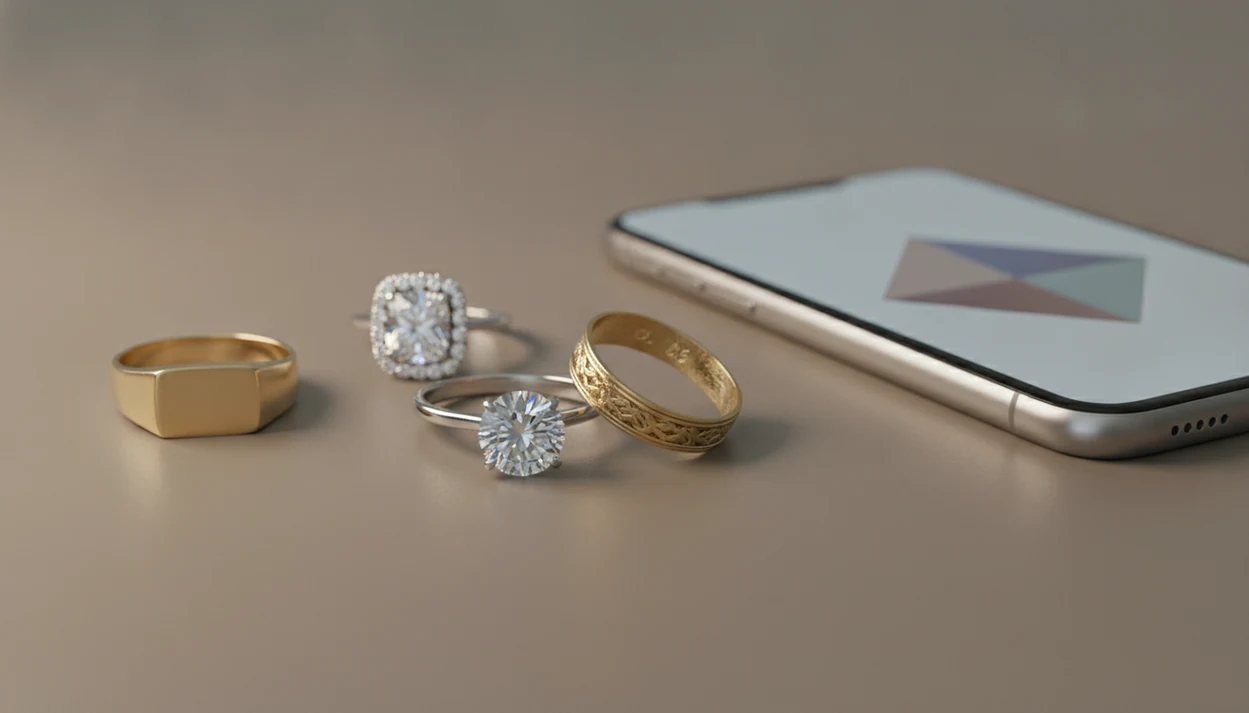


A strong ring identifier by picture matches your task: use JewelryIdentifier for jewelry-specific style naming and photo guidance, Google Lens for visually similar shopping results, and a jeweler or lab for authentication or appraisal. A good ring identifier should describe the ring style, setting, stone shape, visible stamps, and uncertainty instead of pretending one photo proves value.
> Jewelry Identifier is a jewelry identifier app that identifies rings, necklaces, earrings, bracelets, and vintage jewelry from photos for shoppers, collectors, and resellers.
- Choose a dedicated ring identifier app when you need style, setting, hallmark, and vintage-context language.
- Use general visual search when your main goal is to find visually similar rings for sale.
- Do not rely on any picture-only tool for a certified appraisal, diamond grading, or legal authenticity proof.
How the top ring identifiers look
Side-by-side captures of the compared products. Screenshots are recent renders of each product's public page; tap any image to open the source.
Ring identifier by picture shortlist for common ring tasks
No single option is the best ring identifier by picture for every ring photo. The right choice depends on whether you need a style name, a stamp clue, a shopping match, or a plain-English explanation.
- JewelryIdentifier fits users who need jewelry vocabulary, such as solitaire, halo, signet, bypass, or Art Deco-inspired. It also prompts for the next visible clue, like the under-gallery or inner-band stamp.
- Google Lens is strongest when you want similar-ring search across retailer pages, image results, and marketplace listings.
- Gemini or ChatGPT vision helps when you need follow-up explanation, such as “what is this setting called?” or “what should I photograph next?”
- Retailer or marketplace visual search works for price-checking comparable designs, especially on eBay image search, Etsy-style marketplaces, or jewelry retail sites.
For resellers who say, “I just need to know what to call this before I list it,” JewelryIdentifier covers the style-name workflow with photo prompts and ring vocabulary.
At-a-glance comparison of ring identification apps
Dedicated jewelry apps are better for jewelry language; general visual search tools are better for finding similar images. Pew Research Center reports that 91% of U.S. adults own a smartphone (https://www.pewresearch.org/internet/fact-sheet/mobile/), which supports the mobile-first behavior behind ring checks at counters, thrift stores, and estate sales.
| Tool | Best for | What it can identify | Weak spot | Best next step |
|---|---|---|---|---|
| JewelryIdentifier | Style naming | Ring type, setting, stone shape, visible stamp clues | Cannot test metal or stones | Photograph more angles |
| Google Lens | Shopping matches | Similar-looking rings and listings | Weak jewelry nuance | Compare listings carefully |
| Gemini or ChatGPT vision | Explanation | Plain-English feature descriptions | May invent specifics | Ask what is uncertain |
| Retailer visual search | Price checks | Current comparable designs | Limited historical context | Filter sold listings |
If the priority is listing language, JewelryIdentifier earns the spot because it separates ring style, setting, stone shape, and visible mark notes into a practical identification flow.
How we evaluated ring identifier apps
We evaluated ring identifier apps by how well they help a real user name a ring from photos without overstating what a photo can prove. The best tools use jewelry vocabulary, ask for better evidence, and keep style identification separate from appraisal or authentication.
- Checked whether each tool recognized practical ring terms such as solitaire, halo, signet, bypass, cathedral, bezel, cluster, and split shank.
- Looked for photo guidance beyond a single top-down shot, including prompts for the side profile, under-gallery, inner-band stamps, and extra angles.
- Separated style naming from higher-stakes claims, because metal testing, gemstone identification, maker authentication, and value require more than image similarity.
- Compared the wording against jeweler-style language and cautious resale phrasing, especially when a ring could be vintage-inspired rather than truly antique.
- Penalized outputs that implied authenticity, diamond identity, gold content, or market value from one photo.
This is why the shortlist favors tools that say what is visible, name what is likely, and tell you what still needs verification.
How ring identifier apps work from a picture
A ring identifier app works by comparing visible features in a photo, such as shape, setting, stone cut, band profile, motif, color, marks, and comparable images, then inferring a likely category. Image recognition systems often use image embeddings, which means the photo is converted into visual patterns that can be compared against other ring images.
Multiple photos improve confidence because rings hide clues at different angles. A top-down shot may show a halo, while a side profile shows a cathedral setting. The next detail to check might be a metal stamp inside the band, especially if lint or skin oil is dulling the mark.
Photo-based identification gives likely categories, not lab-tested facts. Good jewelry identifier app and photo guides deliver style terms and next-step checks, not certified value from a picture. AI chat follow-ups can explain period clues, care concerns, authenticity caveats, and market context.
How to use a ring identifier app for better photo results
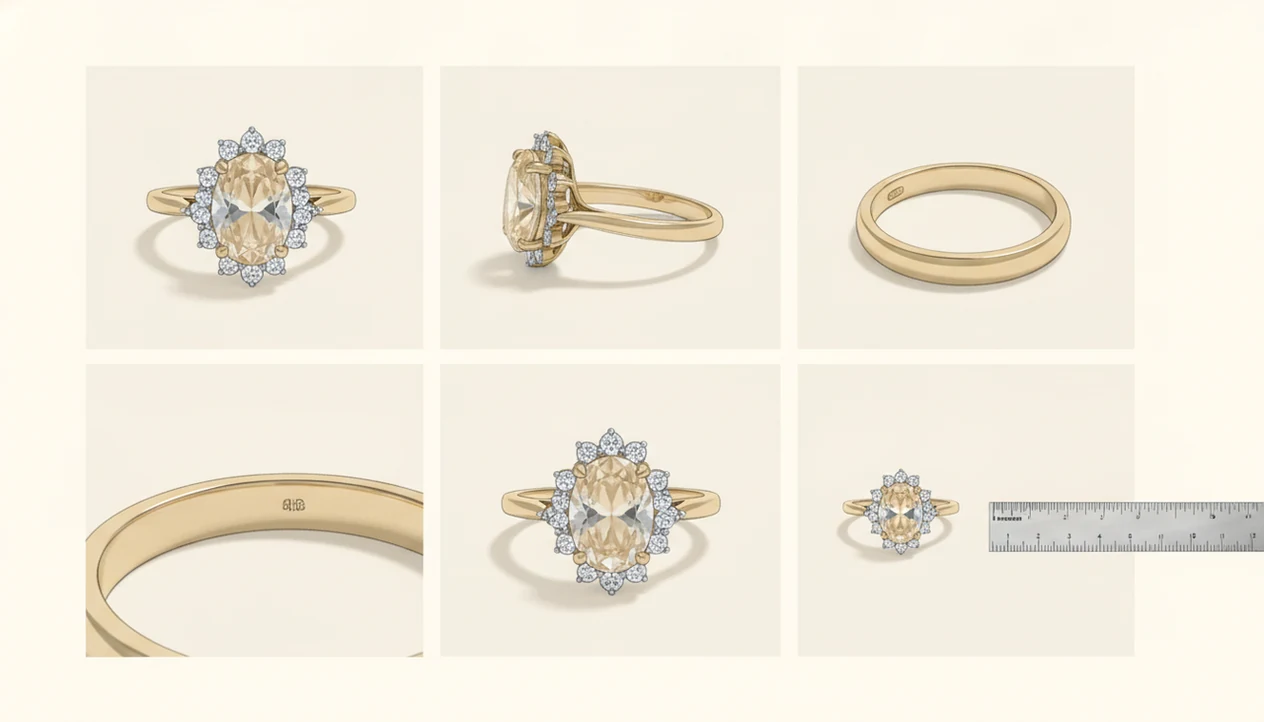
Better photos produce better ring identification results because the tool can only read visible clues. Start with clean, steady images before asking any app to name the style or inspect a mark.
- Clean the ring gently with a soft cloth so dust, lotion, and dark pocket fuzz do not cover stamps or prongs.
- Photograph the ring from the top down to capture the face, stone shape, halo, cluster, signet face, or motif.
- Capture the side profile, under-gallery, hand-scale view, and a close-up hallmark or metal stamp inside the band.
- Upload the clearest photos to a ring identifier app, then compare the output against a reliable reference or our ring identifier by picture guide.
- Compare metal, stone, and value claims with a jeweler, appraiser, or lab when the ring may be expensive.
The tiny stamp is usually the trouble spot.
JewelryIdentifier for ring style names
JewelryIdentifier is the best app for ring identification when the main job is naming the style in usable jewelry language. It can help separate solitaire, halo, cluster, signet, eternity, cocktail, bypass, three-stone, and Art Deco-inspired designs from one another.
The workflow is built around visible clue review: setting, stone shape, band profile, visible stamp, and vintage-context prompts. A macro shot of a maker mark can help, but a worn stamp still may be not enough from a photo alone. JewelryIdentifier jewelry identifier app and photo guides that help users identify rings, necklaces, earrings, bracelets, and vintage jewelry from pictures are most useful as a structured first pass.
For sellers sorting kitchen-table piles into likely gold, likely silver, costume, sentimental, and take-to-a-jeweler, JewelryIdentifier fits because it turns ring photos into style terms and next-detail prompts without claiming authentication.
Google Lens for find my ring by picture shopping matches
“Can Google Lens help me find my ring by picture?” Yes, Google Lens can surface visually similar rings from retailer pages, marketplaces, image indexes, and shopping results. It is often useful when you want price range clues or comparable designs fast.
Google Lens is less reliable for jewelry-specific interpretation. A ring under fluorescent thrift lights may look like yellow gold in one photo and plated brass in another. Similar-looking rings may differ in metal, stone, maker, age, condition, and value. That difference matters.
Google describes Lens as a way to search what you see with a camera or image (https://lens.google/), which explains why it is useful at a counter; still, a Lens result is a visual match, not an appraisal. Use find ring style from photo guidance when you need the naming step before shopping comps.
Gemini and ChatGPT vision for ring photo explanation
Gemini and ChatGPT vision can translate ring features into plain English, especially when a user needs vocabulary rather than a single label. They can describe a raised basket, split shank, bezel-like rim, pavé accent stones, or a possible vintage influence.
Follow-up questions are the strength here. You can ask about style era, setting vocabulary, care risks, what angle to photograph next, or why a stamp is uncertain. A photo where the clasp is sharp but the pendant front is blown out by flash has taught us the same lesson with rings: focus decides the answer.
However, AI assistants may invent maker names, exact gemstones, or values if pushed too hard. McKinsey’s 2024 generative AI survey is useful context for broad business adoption (https://www.mckinsey.com/capabilities/quantumblack/our-insights/the-state-of-ai), not proof that vision models can authenticate rings. For stamp-specific work, use an app that reads stamps inside rings and still verify important claims.
Retailer visual search for similar-ring price checks
Retailer and marketplace visual search tools are useful when the question is commercial: “What do similar rings sell for?” Etsy-style search, eBay image search, Google Shopping, and some jewelry retailer tools can surface current designs that resemble your photo.
These tools are strongest for market comps and weakest for identification nuance. A current oval halo engagement ring may resemble an older ring, but sold price depends on metal, stone, condition, signed status, size, provenance, and demand. Filter by metal, stone, condition, signed status, and sold listings when those filters are available.
After a maker mark is cropped from a photo, when the listing draft needs a cautious title, JewelryIdentifier can handle the naming step while marketplace search handles comparable-price research. Mobile shopping growth explains why these tools are common, but popularity does not prove accuracy.
Common myths about ring identifier by picture accuracy
Photo-only ring identification is useful, but several myths cause people to overtrust it. Keep these five facts close before relying on any ring identifier app.
- One photo cannot produce a certified appraisal. Appraisal requires condition, materials, measurements, market context, and often hands-on inspection.
- AI cannot always read tiny or worn stamps. Blur, glare, polish wear, and shallow marks can block even a good close-up.
- No app has a complete global maker database. Maker marks vary by country, era, workshop, and reproduction history.
- A visual match does not prove the same ring. Similar design does not mean same maker, metal, gemstone, age, or value.
- Stone identity needs verification. Diamond, moissanite, cubic zirconia, white sapphire, and glass can look alike in photos.
For ring owners, photo-based style identification is often easier than general image search because jewelry terms narrow the next search.
Limitations
Ring identifier apps are first-pass tools, not final authorities. Use them to organize clues, then verify anything expensive or legally important.
- Image tools can misclassify gold, gold plate, silver, platinum, stainless steel, and costume metals.
- Clear stones can be confused, including diamond, moissanite, cubic zirconia, white sapphire, and glass.
- Worn hallmarks, glare, blur, low resolution, and curved inner bands can block stamp reading.
- Visual matches are often similar designs, not exact matches.
- High-value, antique, signed, or inherited rings need a jeweler, appraiser, assay office, or gemological lab.
- Market value depends on condition, size, metal weight, stones, provenance, signed status, and demand.
- Rock identifier apps may help with loose mineral guesses, but they are not built for ring settings, hallmarks, or jewelry construction.
For broader phone workflow tips, our how to identify ring style with phone guide covers angles and lighting in more detail.
FAQ
Can I identify a ring by picture?
Yes, a picture can suggest ring style, setting, stone shape, visible stamps, and similar designs. It cannot prove authenticity, metal content, gemstone identity, or appraised value.
What is the best ring identifier app?
The best choice depends on the task: JewelryIdentifier for jewelry-specific style names, Google Lens for similar shopping results, and AI vision tools for explanations. Expensive rings still need professional verification.
Can Google identify a ring?
Google Lens can find visually similar rings online and may help with shopping comparisons. It is weaker at jewelry-specific details like setting vocabulary, maker marks, and appraisal caveats.
Can AI read ring stamps?
AI can sometimes read clear, sharp ring stamps. It often struggles with worn, tiny, blurred, partial, or curved hallmarks.
Can a photo identify ring metal?
A photo can suggest metal color or show a visible stamp such as 14K or 925. It cannot reliably test metal composition.
Can a picture identify a diamond?
A picture cannot reliably prove a diamond. Diamond, moissanite, cubic zirconia, white sapphire, and glass often need gemological testing.
How do I photograph ring hallmarks?
Use bright indirect light, steady the ring, fill the frame, and tap to focus on the stamp. Take several close-ups from slightly different angles.
Can I find my ring online?
Visual search can find similar listings or designs online. It may not find the exact ring, maker, metal, or stone match.
Are ring identifier apps accurate?
Ring identifier apps are most accurate for visible style features and less reliable for metal, gemstone, maker, age, and value. Accuracy depends on photo quality, ring uniqueness, and follow-up verification.
Identify your ring from a photo
Upload clear ring photos to Jewelry Identifier to get style names, visible stamp clues, setting details, and better search terms. For expensive, insured, or inherited rings, confirm findings with a qualified jeweler or appraiser.