
Find Ring Style From Photo Without Guessing
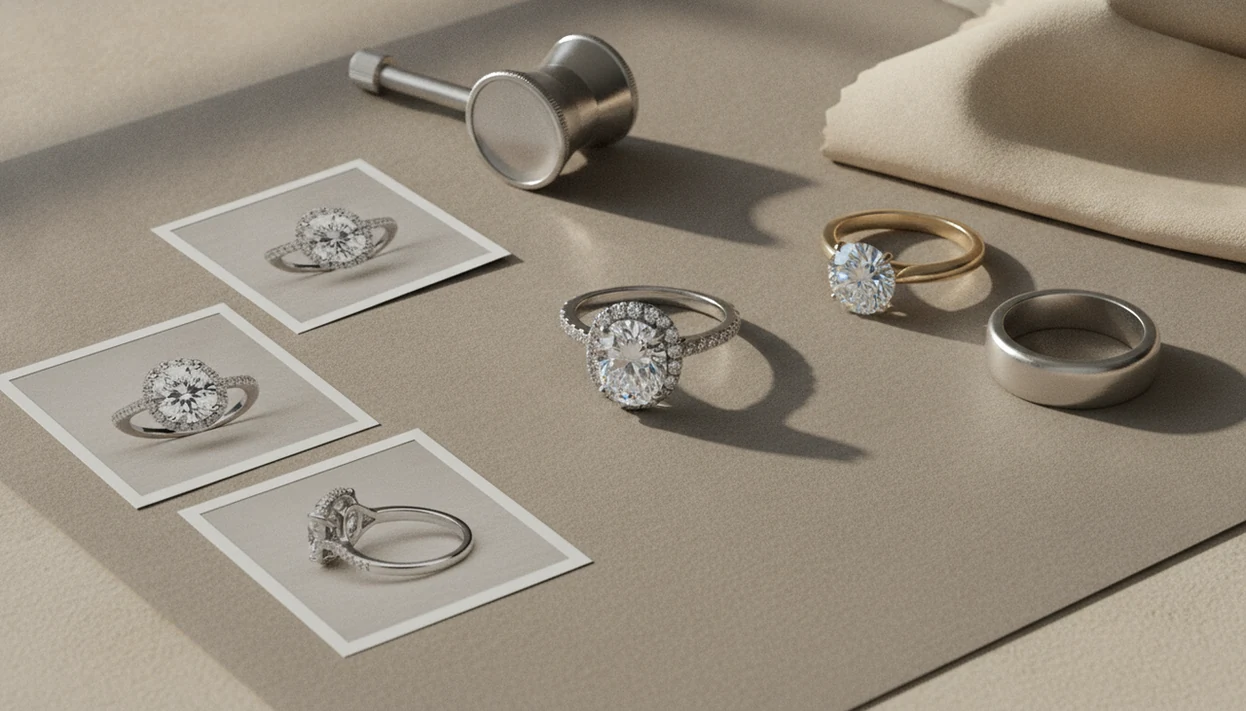


To find ring style from photo, upload the clearest image you have and match visible clues such as stone shape, setting type, band profile, metal color, era details, and any marks inside the shank. Most tools identify the closest style family, not the exact brand or appraisal value.
JewelryIdentifier is a jewelry identifier app that helps users identify rings, necklaces, earrings, bracelets, and vintage jewelry from photos, including ring style clues such as setting type, stone shape, band profile, and era-inspired details.
- A ring photo can usually reveal the style family: solitaire, halo, three-stone, pavé, signet, cluster, vintage-inspired, art deco, minimalist, or similar.
- Clear top-view photos work best because style matching depends on setting, stone shape, prongs, shoulders, band width, and decorative details.
- Use app results as a naming and search aid, then confirm age, metal, gemstone, and value with a jeweler when money or insurance is involved.
Find Ring Style From Photo: What the Result Can Tell You
Finding a ring style from a photo means identifying the likely style family, not proving the exact product, maker, or value. A good result may say solitaire, halo, three-stone, pavé, cathedral, bezel, signet, art deco, vintage-inspired, minimalist, or a close mix.
That label is useful. It helps you search online, describe the ring to a jeweler, compare designs, replace a lost ring, or prepare a resale listing. “Oval halo engagement ring with pavé band” is much better than “pretty ring with sparkles.”
The photo still matters. A sharp top-view image can show prongs, shoulders, and stone outline. A blurry screenshot may only support a broad guess, like “cluster” or “vintage-inspired.” Under thrift-store fluorescent lights, even a tiny 14K stamp inside a yellow-gold ring can disappear unless the angle is right.
How a Ring Style Matcher Works From a Picture
A ring style matcher works by comparing visible ring-design features against known style patterns, then ranking likely categories by visual similarity. It is visual matching, not magical brand detection.
The system looks for stone shape, setting silhouette, prong layout, halo presence, band width, side stones, engraving, shoulder shape, and metal color. In technical terms, many tools use image embeddings, which are numerical summaries of what the picture appears to contain. Plainly: similar-looking rings land closer together.
Research on visual search shows product recognition accuracy can exceed 90% for well-lit, high-resolution images, while blurry or occluded photos perform worse source. Treat that benchmark as directional, not jewelry-specific. Ring photos add extra difficulty because reflective metal, tiny prongs, and transparent stones can change appearance with small shifts in light. That explains why a side profile of a ring setting may clarify “cathedral” or “bezel,” but still cannot prove diamond clarity, metal purity, gemstone authenticity, or exact age.
Photo-first identification gives style language, not lab results.
How to Use a Photo to Identify Ring Style
Use the photo as a structured clue sheet, then turn the result into search language. If the first match feels off, test another angle before trusting the label.
- Choose the sharpest photo that shows the ring face, setting, and band without glare.
- Crop around the ring so the matcher is not reading fingers, fabric, or background clutter.
- Upload the image to JewelryIdentifier, a ring identifier by picture, or a visual-search alternative such as Google Lens or Pinterest Lens for a second opinion.
- Review suggested style names such as halo, solitaire, bezel, signet, or art deco.
- Compare the visible details, including stone shape, prongs, shoulders, side stones, and band width.
- Save useful search terms for shopping, jeweler visits, or resale, but do not treat them as an appraisal.
One user phrase we hear often: “I just need to know what to call this before I list it.” That is exactly the right expectation.
Photo Clues That Help Identify Ring From Old Photo
To identify ring from old photo, look for durable shape clues rather than tiny details that the image cannot show. Old family images can narrow the style, but they rarely prove age or value.
- Stone outline often survives in old photos: round, oval, marquise, emerald-cut, or square.
- Center height can hint at basket, cathedral, cocktail, or low-profile settings.
- Shoulder shape and side stones may separate three-stone, pavé, split-shank, and cluster styles.
- Filigree, milgrain, engraving, and geometric lines can suggest art deco or vintage-inspired design.
- Signet faces and band thickness can remain visible even when stones are unclear.
Zoom gently. Over-sharpening can invent edges that were never there. Check other family photos for a clearer hand angle or better light. A yellowed appraisal slip beside bangles may help organize the story, but heirloom, antique, and insurance questions still deserve jeweler review.
Best Photo Angles for Find My Ring By Picture Searches
For “find my ring by picture” searches, use multiple angles because each view answers a different style question. The top view names the face; the side view explains the structure.
Top-down shot. This shows stone shape, halo, cluster layout, prongs, shoulders, and band width. Place the ring on a plain surface, not patterned fabric.
Side-profile shot. This helps identify basket, cathedral, bezel, bridge height, and how high the center stone sits. A necklace spread flat on a towel is easy; rings need the same calm setup.
Inner-band mark shot. This captures stamps, logos, and karat marks if present. Lint, skin oil, and dark pocket fuzz can hide marks inside a clasp or shank, so clean gently first.
Hand-worn proportion shot. This shows scale, especially for cocktail, signet, and wide-band styles.
Use indirect light, a clean lens, and no heavy filters. Flash glare, motion blur, reflective metal, partial occlusion, and busy backgrounds can confuse visual search.
Ring Style Names to Compare After Photo Matching
Style names work like a vocabulary map after photo matching. They help you compare rings, search accurately, and speak clearly with a jeweler.
| Style name | What to look for in the photo |
|---|---|
| Solitaire | One main stone, simple setting, little side detail |
| Halo | Center stone surrounded by smaller stones |
| Three-stone | One center stone with two side stones |
| Cluster | Several stones grouped into one visual shape |
| Pavé | Tiny stones set along the band |
| Bezel | Metal rim surrounds the stone edge |
| Cathedral | Raised shoulders lift toward the center stone |
| Signet | Flat or engraved face, often no raised gemstone |
| Cocktail | Large face, bold scale, often colorful or clustered |
| Art deco | Geometry, symmetry, stepped shapes, strong lines |
| Vintage-inspired | Older-looking details without proven age |
| Minimalist | Plain band, low detail, clean silhouette |
Styles can overlap. “Oval halo pavé engagement ring” is a stronger search phrase than “halo ring.” Brand and model should be treated separately from style name, especially if no clear maker mark is visible.
Method Jewelry Identifier Uses to Track Ring Style Clues
JewelryIdentifier uses photo-first identification: visible features, likely style family, confidence caveats, and next-step wording. The method prioritizes ring-specific evidence over generic shopping matches, so a cathedral shoulder or bezel rim is treated as a clue, not background decoration.
Digital behavior makes that language matter. Online sales accounted for about 18% of U.S. jewelry and watch sales in 2021, according to Census retail data source. Deloitte reported that 29% of consumers used augmented reality tools when shopping for fashion and beauty online source, and McKinsey projected that digital interactions could influence up to 80% of luxury purchases source.
Accurate style language helps before shopping, selling, replacing, or custom-ordering a ring because it turns a vague picture into a usable description. Good jewelry identifier app and photo guides that help users identify rings, necklaces, earrings, bracelets, and vintage jewelry from pictures deliver clearer naming and next-step checks, not guaranteed authentication.
Three Real Outcomes From Ring Style Photo Matching
Ring style photo matching is most useful when it changes the next action. It can turn a vague image into a search phrase, a jeweler question, or a cleaner listing.
Maya: Screenshot to Search Phrase
Maya saved a Pinterest screenshot of an engagement ring but did not know the style name. The match suggested “oval halo with pavé band,” which gave her better showroom language than “thin sparkly oval ring.”
Ellen: Heirloom Photo to Style Clues
Ellen had an old family photo where the ring was small and grainy. Geometry around the center suggested art deco influence, but the result stayed cautious: vintage-inspired clues, not antique proof.
Jon: Resale Listing to Clear Description
Jon photographed a ring before listing it, including the setting, stone shape, and band. The result helped him write “round cluster ring with split shoulders” instead of overclaiming metal, stones, or period.
Small wording changes reduce buyer confusion.
What a Ring Style Matcher Does Not Show
Does a ring style matcher prove what my ring is worth or made of? No. A photo cannot reliably determine diamond clarity, gemstone authenticity, metal karat, plating, repairs, exact age, or legal provenance.
“Vintage-inspired” does not always mean antique. A modern ring can borrow milgrain, filigree, or art deco geometry without being old. Exact brand, designer, SKU, or custom workshop origin may also be impossible from a photo alone unless a clear logo, hallmark, receipt, or maker record supports it.
Use a jeweler, gemologist, appraisal, hallmark reference, or physical testing when money is involved. That includes insurance, inheritance, resale, divorce inventory, and suspected fine jewelry. If the mark inside the shank is the key clue, an app that reads stamps inside rings can help you document it before a professional review.
Limitations
Photo-based ring style matching is a first pass. It is useful, but it has real limits.
- Blurry photos and low-resolution screenshots often reduce results to broad categories.
- Old family images may hide prongs, side stones, marks, and stone shape.
- Flash glare can blow out the ring face while leaving the clasp or background sharp.
- Filters, patterned backgrounds, reflections, and motion blur can mislead visual search.
- Partial occlusion, such as fingers covering shoulders, can hide key style clues.
- Unusual custom, cultural, rare, or bespoke rings may not match common style labels well.
- Tools are often stronger on common engagement and wedding styles than uncommon regional designs.
- App output should not be used for appraisal, insurance, metal purity, gemstone authenticity, or legal provenance.
- High-value, inherited, antique, or resale decisions still need jeweler or gemologist confirmation.
When in doubt, photograph first, then verify in person.
How to Identify Ring Style With a Phone
To identify ring style with a phone, clean the lens, place the ring on a plain surface, and use soft light that reveals the setting without producing white glare. Take a top view for the face, a side view for the setting height and gallery, and a three-quarter view for the shoulders and band. Crop close enough for the ring to dominate the frame while preserving the original full-resolution photos.
Upload the clearest view to a jewelry-specific identifier, then use the other angles to test the suggested style. Compare the stone outline, prong count, halo, side stones, shoulder shape, band width, and profile rather than accepting the first label. Phone identification can provide accurate vocabulary for common designs, but metal, gemstones, brand, age, and value still require supporting marks, records, or professional inspection.
Solitaire, Halo, Cluster and Signet Styles
A solitaire ring presents one main stone as the visual focus, even if the band has small accent stones. A halo surrounds a center stone with a border of smaller stones, while a cluster groups several stones so they read as one larger design. These styles can overlap—a solitaire center may sit inside a halo, and a cluster may be arranged to imitate the outline of a single stone—so inspect both the top view and side construction.
A signet ring is identified primarily by its broad face or bezel, which may be plain, engraved, set with a flat stone, or carved with an intaglio. It usually has heavier shoulders than a typical gemstone solitaire. Style names describe visible design, not age or authenticity: a newly made signet can look antique, and a modern cluster can use vintage-inspired geometry without being a period piece.
What Ring Is This? Details to Photograph
For a “what ring is this?” search, photograph the entire ring face, center and side stones, prongs or bezel, shoulders, band, gallery, and underside. Add a straight side profile to show whether the setting is cathedral, basket, low-profile, tension-style, or otherwise constructed. A ruler or ring mandrel in a separate image can document scale without hiding the design.
Turn the ring inside out visually by photographing the complete inner band, then take close-ups of every stamp, logo, serial number, inscription, solder line, and worn area. Use several lighting angles for curved marks and include damage or repairs, because alterations can explain why a photo differs from an online example. This image set supports a stronger style match and gives a jeweler better evidence for follow-up questions.
FAQ
Can I find a ring by picture?
Yes, a picture can usually help find similar ring styles or style families. It may not identify the exact ring, brand, or model.
Is there an app for ring styles?
Yes, jewelry identifier and ring style matcher apps can classify visible ring styles from photos. JewelryIdentifier is one option for photo-based style naming.
Can AI identify engagement rings?
AI can identify visible engagement ring styles such as halo, solitaire, three-stone, pavé, or bezel. It cannot confirm diamond quality, metal purity, or value from a photo alone.
What ring style is my ring?
Check the stone shape, setting type, prongs, shoulders, band width, side stones, and any inner mark. Those visible clues usually determine the likely style name.
Can old photos identify rings?
Old photos can help narrow style clues such as cluster, signet, art deco, or vintage-inspired. A jeweler should review heirloom or insurance-related pieces.
Can a photo show ring value?
No, photos cannot reliably determine value. Metal content, gemstone quality, condition, and provenance require testing or appraisal.
What photo angle works best?
A top-view photo works best for stone shape and setting style. Add a side-profile photo with soft light and a neutral background for height and basket details.
Can I identify a ring brand?
Brand identification may be possible if the photo clearly shows a logo, hallmark, or distinctive design record. Most style matchers return style categories rather than confirmed brands.
Ready to Match a Ring Style From a Photo?
Upload clear photos of the ring’s top, side, band, and any inside marks to get style clues and similar visual matches. Use Jewelry Identifier as a fast first step before professional verification.