
Jewelry Appraisal App vs Professional Appraisal: Limits, Uses, and Risks
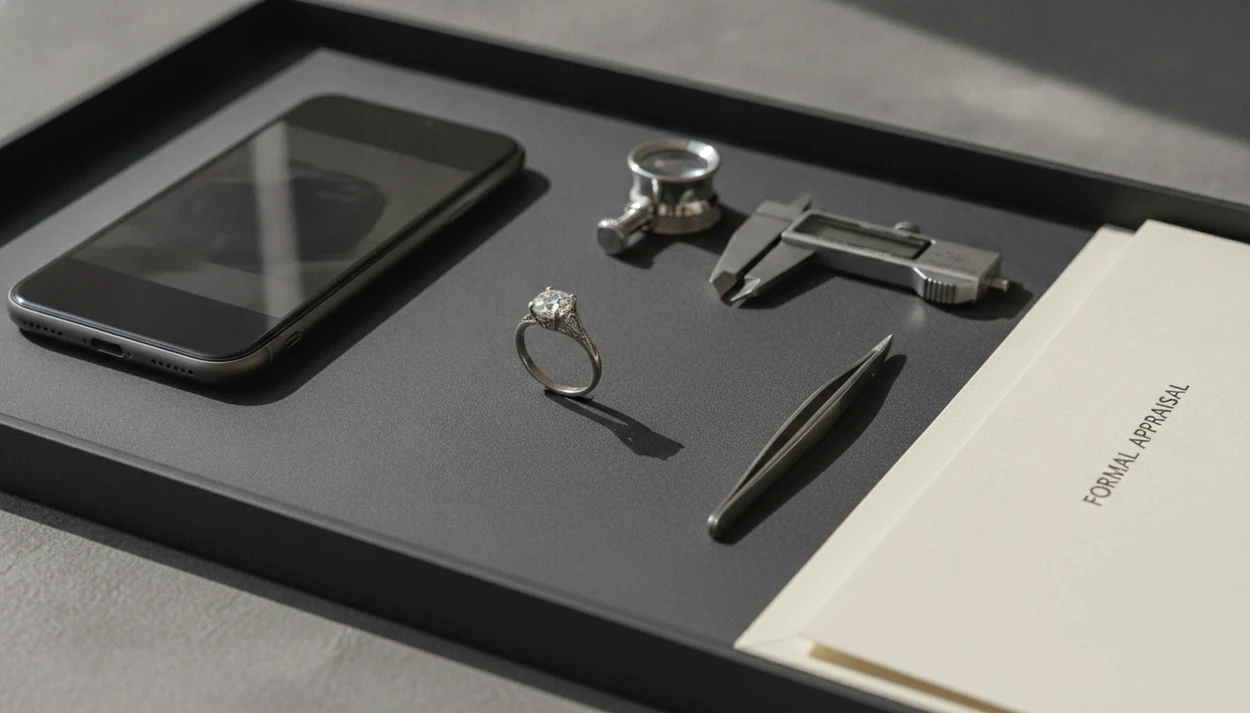


A professional appraisal wins when the value must be documented for insurance, estates, taxes, legal disputes, or major resale decisions; a jewelry appraisal app vs professional appraisal comparison mainly comes down to convenience versus verified evidence. Apps are useful for photo identification and rough sorting, but they cannot test metal, confirm gemstones, or issue an official valuation report.
> This guide is educational, not legal, tax, insurance, or appraisal advice. Use photo-based tools for identification and triage only; rely on a qualified appraiser, insurer, tax adviser, or attorney when value affects coverage, estates, taxes, disputes, or resale decisions.
- Use a jewelry appraisal app for quick photo identification, style clues, maker mark hints, and rough value ranges.
- Use a professional appraisal when you need a written value for insurance, estate, legal, tax, or high-value resale purposes.
- Photo appraisal, formal appraisal, insurance valuation, and gem lab reports are separate tools with different standards.
Jewelry appraisal app vs professional appraisal limits, side by side
Side-by-side captures of the compared products. Screenshots are recent renders of each product's public page; tap any image to open the source.

Jewelry appraisal app vs professional appraisal at a glance
A jewelry app identifies and estimates from visible clues, while a professional appraiser documents value for a stated purpose. Insurance companies usually want formal appraisal documentation, not an app screenshot. For jewelry coverage, insurers commonly ask for item descriptions, receipts, appraisals, or other documentation before scheduling high-value pieces; the Insurance Information Institute recommends documenting jewelry and discussing coverage limits with your insurer source.
| Option | What it can do | What it cannot do | Typical use |
|---|---|---|---|
| Photo app | Identify likely category, style, metal color, stone shape, and visible marks | Test metal, confirm stones, or issue official value | Quick sorting and vocabulary |
| Online estimate | Give a rough range from photos and user notes | Guarantee authenticity or insurer acceptance | Low-risk curiosity or resale prep |
| Professional appraisal | Inspect, measure, document, research, and assign value type | Guarantee final resale price | Insurance, estate, tax, legal, high-value sale |
| Gem lab report | Grade a stone’s identity and characteristics | Assign total jewelry value | Diamond or gemstone verification |
We have seen a clasp photo come in sharp while the pendant front was blown out by flash. That is enough for a chain clue, not enough for value.
How jewelry appraisal apps work from photo identification
A jewelry appraisal app works by turning photos into visual signals, then matching those signals against patterns for object classification, style terms, and likely category. In plain English, it compares what the camera can see with jewelry examples it has learned.
Photo-based tools may infer metal color, setting type, stone shape, era clues, bracelet construction, or visible maker marks. Tools like JewelryIdentifier can help identify rings, necklaces, earrings, bracelets, maker marks, metals, styles, and vintage pieces from images. That makes it useful as a jewelry identifier by photo, not as a formal valuation method.
The camera does not know hidden weight, alloy purity, gemstone treatments, old repairs, or stone substitutions. Lint, skin oil, and dark pocket fuzz can hide a mark inside a bracelet clasp. Sometimes the next detail to check is simply “clean the mark and photograph it again.”
How to use a jewelry appraisal app before a professional appraisal
Use an app before an appraisal to organize evidence, name visible features, and decide what deserves paid review. Treat the result as a sorting file, not insurance proof.
- Photograph the front, back, side profile, and any worn areas in natural light.
- Capture the clasp, hallmarks, maker marks, stone closeups, and a scale reference beside the item.
- Compare the app’s style terms against a reliable reference before repeating them in a listing.
- Save screenshots, original photos, measurements, and notes in one folder for the appraiser.
- Decide which pieces need hands-on confirmation because value, law, insurance, or authenticity matters.
The most useful prep photo often looks boring: a necklace measured beside a ruler, with the clasp details visible. If privacy worries you, review whether is it safe to upload jewelry photos before sending images to any service.
Where a jewelry appraisal app wins for quick identification
A jewelry appraisal app wins when the question is “what should I call this?” rather than “what is its documented value?” For low-risk sorting, photo identification is often easier than booking an appraisal because it gives fast vocabulary before money is involved.
- Apps help with curiosity pieces, thrift finds, and inherited jewelry sorting.
- Estate box triage is easier when pieces are grouped as likely gold, likely silver, costume, sentimental, and take-to-a-jeweler.
- Resale listing prep improves when you can name a ring style, necklace chain type, earring form, bracelet construction, or stone shape.
- Maker mark hints help users ask a jeweler more precise questions.
- Style research becomes faster when the app suggests searchable terms.
Are jewelry appraisal apps accurate? They can be useful for visible identification, but accuracy drops when value depends on metal purity, gemstone identity, condition, or provenance.
A user phrase we hear often: “I just need to know what to call this before I list it.”
Where professional appraisal wins for insurance and estates
A professional appraisal is a formal written valuation for a specific purpose, such as insurance scheduling, estate settlement, divorce, probate, tax donation, legal disputes, or high-value sales. It wins when documentation and accountability matter.
A qualified appraiser records the item description, measurements, condition notes, photographs, methodology, market research, and stated value type. Credentials and standards matter because two similar rings can require different conclusions after testing, weighing, and close inspection.
When hiring an appraiser, ask whether the report is prepared for the specific intended use and whether the appraiser follows USPAP, the appraisal standards maintained by The Appraisal Foundation source.
Jewelry evaluation is also skilled work. The U.S. Bureau of Labor Statistics reported 18,100 jobs for jewelers and precious stone and metal workers in May 2024, with a median annual wage of $49,680 source. That workforce includes people trained to handle materials, settings, repairs, and precious stones.
Under thrift-store fluorescent lights, even a tiny 14K stamp inside a yellow-gold ring can be hard to read. The loupe still matters.
Online jewelry appraisal limits for photos, metals, and gemstones
Online jewelry appraisal limits start with physical testing: photos cannot confirm gold karat, silver purity, platinum content, plating, stone identity, treatments, synthetic stones, fracture filling, or total carat weight. A picture can suggest; it cannot assay.
The FTC Jewelry Guides treat metal quality, gemstone identity, treatments, and simulated or synthetic stones as material jewelry claims, which is why photo-only identification should not be used as proof of those facts source.
- Metal color can be misleading under warm bulbs, filters, or heavy wear.
- A hallmark may be missing, fake, partly polished away, or hidden by dirt.
- Vintage, damaged, custom, repaired, plated, or stone-substituted pieces are higher risk.
- Camera angle can make a stone look larger, cleaner, or more saturated than it is.
- Total carat weight requires measurement, calculation, records, or stone removal in some cases.
A good photo guide can deliver style terms, visible clue notes, and next-step checks, not verified purity, legal value, or gemstone grading. For a deeper metal-specific boundary, the practical question is can an app tell if jewelry is real gold.
Photo appraisal vs jeweler value types
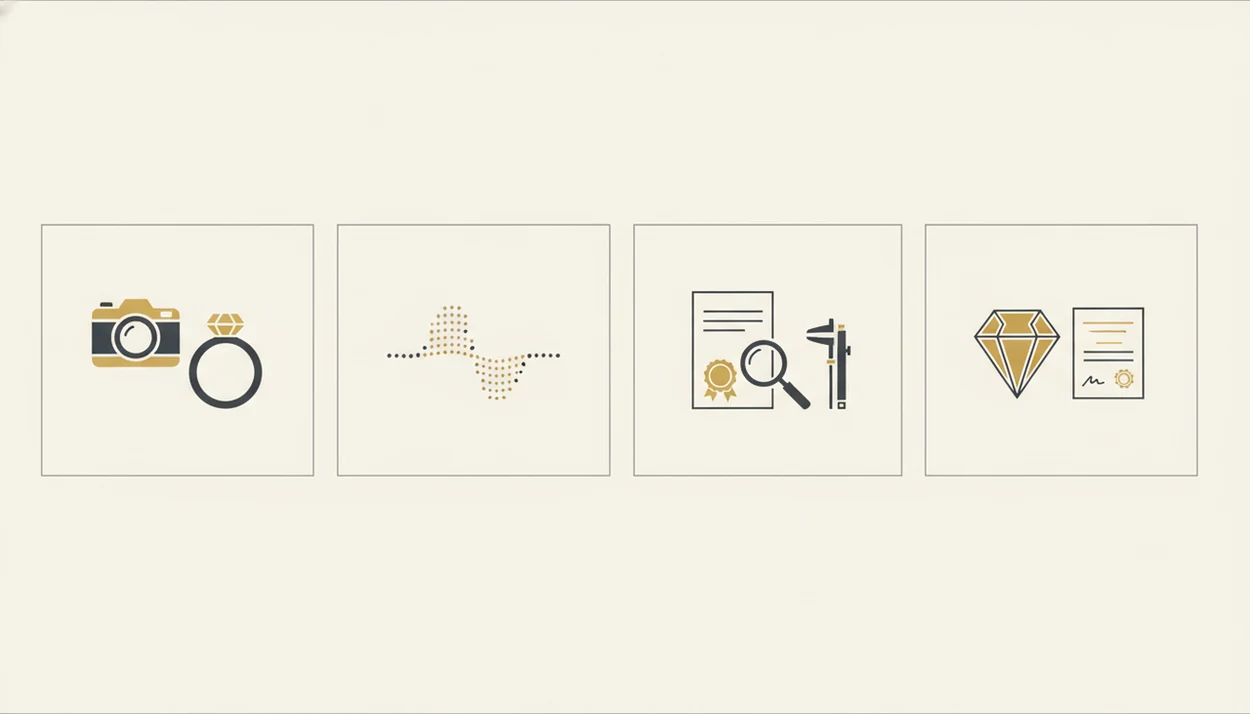
Photo appraisal vs jeweler valuation gets confusing because one item can have several legitimate values. The correct number depends on the purpose, not just the object.
| Value type | What it means | Why it differs |
|---|---|---|
| Insurance replacement value | Cost to replace with a similar item | Often higher than cash resale |
| Fair market value | Likely price between informed buyer and seller | Used in estate or tax contexts |
| Resale value | Expected sale price in a chosen market | Depends on platform, timing, demand |
| Liquidation value | Faster-sale value under pressure | Usually lower |
| Scrap value | Metal value after removing design and retail factors | Ignores most style value |
| Estate value | Purpose-specific estate figure | Depends on jurisdiction and method |
Insurance replacement value
Insurance replacement value is not the same as what a buyer will hand you today. It often reflects replacement cost through a retail channel.
Fair market and resale value
Fair market and resale values depend on buyer behavior, venue, condition, and demand. A tray of mixed costume rings at a thrift counter proves the point quickly.
Gem lab report value gap
A gem lab grades a stone; an appraiser assigns value to the jewelry item. Those are related documents, not substitutes.
Jewelry appraisal app vs professional appraisal cost and timing
Apps are usually faster and cheaper for preliminary identification, especially when the piece is low-risk. Professional appraisals cost more because they include inspection, testing, research, documentation, and liability.
| Choice | Speed | Cost level | Documentation strength | Choose when |
|---|---|---|---|---|
| App | Minutes | Low | Informal | Low-risk sorting |
| Online estimate | Hours to days | Low to medium | Varies | Convenience matters |
| Mobile jewelry appraisal | Scheduled | Medium to high | Depends on provider | You need in-person help at home |
| Professional appraisal | Scheduled | Higher | Formal written report | Money, insurance, law, or authenticity matters |
Choose an app for low-risk sorting; choose a professional when money, insurance, law, or authenticity matters. Some online appraisal services produce formal reports, but others only provide informal estimates. Check the report purpose before relying on it.
Apps such as JewelryIdentifier, Google Lens, and eBay image search can help with early comparison. They should not be treated as a substitute for a qualified appraiser.
Evidence and appraisal standards to check
Check whether the document matches the decision you are making: insurance, estate, tax, resale, or simple identification. Good evidence names its standard, its scope, and its limits.
- Ask whether a formal appraisal follows USPAP, the baseline appraisal standard commonly used for professional reports in the United States.
- Review metal, gemstone, synthetic-stone, and treatment language against the FTC Jewelry Guides, because those details are material consumer disclosures.
- Separate a gem lab report from an appraisal; GIA-style grading can document a stone’s identity and characteristics, but it does not value the whole ring, bracelet, or pendant.
- Confirm what your insurer needs for scheduled jewelry coverage, such as item descriptions, receipts, appraisals, photos, serial numbers, or updated values.
- Flag the parts that remain judgment-based: market selection, value type, condition impact, comparable sales, workmanship, brand strength, and likely replacement channel.
Even with a clean lab report and a polished appraisal, two experts may weigh market evidence differently. Documentation narrows the argument; it does not turn jewelry value into a single permanent number.
Common myths about jewelry appraisal apps and appraisers
Most bad decisions start with the wrong document. These myths are common in app stores, resale groups, and forum threads.
- Myth: an AI appraisal can replace jeweler inspection. Photo-only tools cannot verify hidden construction, metal purity, or gemstone treatments.
- Myth: an app value is the amount the item will sell for. A listed estimate is not a buyer, a bid, or a completed sale.
- Myth: a lab report and appraisal are the same. A lab report grades a stone, while an appraisal assigns monetary value to jewelry.
- Myth: any online appraisal is accepted by insurers. Insurers typically require formal documentation that meets their policy rules.
- Myth: a professional appraisal never expires or changes. Values move with metal prices, gemstone markets, condition, and replacement costs.
JewelryIdentifier jewelry identifier app and photo guides that help users identify rings, necklaces, earrings, bracelets, and vintage jewelry from pictures can support vocabulary and sorting. Formal value still needs the right valuation method.
Limitations
Both app-based identification and professional appraisal have limits. The safer choice depends on risk, purpose, and what must be proven.
- Photo apps cannot physically test materials, verify treatments, weigh hidden components, or confirm substitutions.
- Professional appraisals are snapshots in time and can become outdated as markets change.
- Appraisals vary by purpose, appraiser skill, documentation quality, methodology, and market conditions.
- Online services range from informal photo estimates to formal written reports, and the difference matters.
- Neither an app nor an appraisal guarantees the final resale price.
- Major insurance, estate, legal, tax, or high-value sale decisions should use qualified appraisers.
- Gem lab reports may be needed when stone identity, grading, treatment, or origin affects value.
- A photo can miss repairs under a setting, thinning prongs, replaced stones, or plating wear.
Small print matters. So does the purpose line on the report.
How to Estimate What Jewelry Is Worth
Start an informal jewelry estimate by identifying the item, recording its weight and measurements, and separating facts from assumptions. Photograph the whole piece and its marks, note the condition, and look for receipts, laboratory reports, branded packaging, or repair records. Then compare genuinely similar items by metal, gemstone, maker, age, and condition. Asking prices can be useful context, but completed sales are stronger evidence of what buyers have recently paid.
A photo app can supply style terms and point to possible comparisons, but it cannot see hidden construction or verify purity and stone quality. Metal weight, gemstone identity, treatments, workmanship, provenance, and current demand can change value substantially. Use a rough range for early sorting, and ask a qualified appraiser for a purpose-specific opinion when the amount will affect insurance, an estate, taxes, a dispute, or a significant sale.
Resale Value Versus Insurance Value
Resale value is the amount a buyer may pay in a particular market after considering condition, demand, selling fees, and the time allowed to find a buyer. Insurance value usually reflects the cost of replacing the item with a comparable piece through an appropriate retail source. Because those questions use different markets and assumptions, an insurance appraisal can be much higher than a dealer offer or the proceeds from an online sale without either figure being automatically wrong.
Always label a value with its purpose and effective date. A quick-sale or liquidation figure may be lower than an orderly resale estimate, while replacement value may include retail sourcing and fabrication costs that a secondhand buyer will not reimburse. Do not advertise an insurance figure as the likely cash price; ask the appraiser which market, value definition, and replacement method the report uses.
Information an Appraiser Needs
An appraiser needs access to the piece plus any records that can support identification and ownership history. Bring receipts, prior appraisals, gemstone grading reports, certificates, maker documents, repair or alteration records, original boxes, and clear family provenance notes. Explain whether the report is for insurance, estate administration, donation, equitable distribution, resale planning, or another purpose, because that choice determines the relevant value definition and research.
Before the appointment, inventory each item with a unique number and photograph the front, back, sides, hallmarks, damage, and accompanying documents. Tell the appraiser about missing stones, replaced clasps, resizing, known treatments, or recent repairs instead of cleaning or restoring evidence away. Complete context helps the professional describe the item accurately, choose suitable comparables, and state any testing limits in the final report.
FAQ
Are jewelry appraisal apps accurate?
Jewelry appraisal apps can help identify visible style, form, marks, and rough category. They are not reliable for verified value, authenticity, metal purity, or gemstone grading.
Can an app value jewelry?
An app may provide a rough estimate or range based on photos and comparison data. It cannot produce a formal appraisal for insurance, estate, tax, or legal use.
Do insurers accept app appraisals?
Insurers typically require formal documentation from a qualified appraiser. An app screenshot is usually not enough for scheduling valuable jewelry.
What is a professional appraisal?
A professional appraisal is a written valuation of a jewelry item for a defined purpose. It usually includes description, photographs, measurements, condition, methodology, and value type.
What is photo appraisal?
Photo appraisal is an image-based identification or estimate made without physical testing. It can be convenient, but it cannot verify hidden material facts.
Can photos identify real gold?
Photos may show color, wear, or a metal stamp, but they cannot verify gold purity. Testing or qualified inspection is needed for confirmation.
Can apps identify real diamonds?
Apps may recognize a diamond-like appearance from a photo. They cannot confirm diamond authenticity, grade, treatments, or substitutes; for details, compare with can an app tell if diamond is real.
Is a lab report an appraisal?
No. A lab report grades a gemstone, while an appraisal assigns monetary value to the jewelry item for a stated purpose.
Which appraisal value matters?
The correct value depends on the purpose: insurance, resale, estate, liquidation, donation, or tax. A high insurance replacement value is not the same as likely cash resale.
When should jewelry be reappraised?
Jewelry should be reappraised periodically because values change over time. Updates are especially important for insurance scheduling, major market changes, or altered condition.
Start with photo identification before paying for a formal appraisal
Use Jewelry Identifier to organize visible clues, stamps, style, and likely category from photos. For insurance, estates, or high-value resale, bring those findings to a qualified professional for verification.