
Gold vs Costume Jewelry From Photos: What You Can Tell Safely
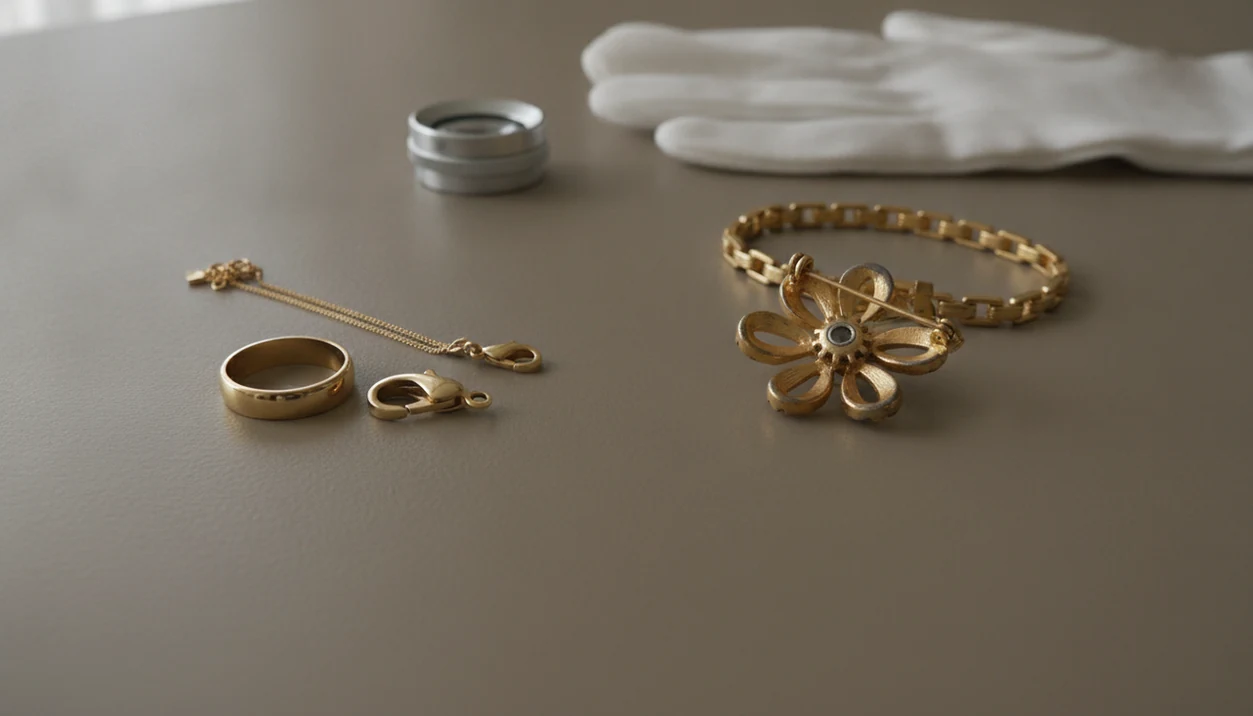


Gold vs costume jewelry from photos is usually judged by visible stamps, wear, construction, stone setting quality, and testing limits, not by yellow color alone. A clear photo can suggest possible solid gold, gold-filled, vermeil, plated, or gold-tone costume jewelry, but it cannot prove metal purity without in-person testing. JewelryIdentifier helps organize those visible clues before you decide whether a piece belongs in the likely gold, likely silver, costume, sentimental, or take-to-a-jeweler pile.
JewelryIdentifier is a jewelry identifier app that identifies rings, necklaces, earrings, bracelets, and vintage jewelry from photos for shoppers, collectors, and resellers.
- Visible karat stamps such as 10K, 14K, 18K, 585, or 750 are among the strongest photo clues, but stamps can be missing, worn, fake, or hard to read.
- Gold-tone costume jewelry often shows plating wear, flaking, greenish corrosion, rough backs, glued stones, or base metal showing through high-contact areas.
- A photo can help you decide whether a piece deserves testing, but acid testing, XRF, density checks, or a jeweler’s appraisal are needed to confirm gold.
Gold vs costume jewelry from photos, side by side
Side-by-side captures of the compared products. Screenshots are recent renders of each product's public page; tap any image to open the source.

Gold vs Costume Jewelry Photo Clue Table
Gold vs costume jewelry from photos works best as a likelihood check, not a proof test. Color alone is one of the weakest clues, especially under warm bulbs, flash, or marketplace compression.
| Visible clue | Possible gold or fine jewelry | Possible gold-tone costume jewelry |
|---|---|---|
| Stamps | 10K, 14K, 18K, 585, 750, clear maker mark | No mark, vague mark, GP, HGE, worn plating mark |
| Color | Even tone on edges, backs, links, clasp | Patchy yellow, orange cast, exposed gray or copper metal |
| Wear | Slow soft wear, no flaking | Peeling, chipping, dark edges |
| Backs | Finished backs, smooth soldering | Rough backs, molded cavities |
| Clasps | Sturdy spring ring, box clasp, secure hinge | Thin decorative clasp, loose crimping |
| Stones | Prong-set, well-aligned | Glued rhinestones, foil backs |
| Weight clues | Feels substantial for size | Looks hollow or stamped thin |
| Next step | Test or appraise | Research brand, then decide |
JewelryIdentifier fits quick sorting because the photo review keeps stamps, wear points, and construction clues in one comparison workflow.
How Gold vs Costume Jewelry From Photos Works
Gold vs costume jewelry from photos works by grouping visible clues into a likelihood call, not by measuring purity, karat, or resale value. The photo can say “this deserves testing” or “this looks plated,” but it cannot prove what the metal is.
The strongest readings come from a clue cluster: hallmark text, mark placement, wear points, construction, and setting style. Color is weaker because lighting, polish, phone white balance, and yellow plating can all shift the tone. Wear points are more useful because raised edges, clasp tongues, jump rings, earring posts, and ring shanks show how the surface behaves where hands and skin actually touch it. Hallmark placement also matters; a clear 14K inside a ring shank or on a clasp tab is more meaningful than a random mark in an odd spot.
- Separate likely solid gold from gold-filled, vermeil, plated, and gold-tone outcomes instead of forcing a yes-or-no answer.
- Compare stamps with wear and construction so one shiny photo does not outweigh obvious flaking or glued stones.
- Flag clear karat marks, consistent wear, finished backs, secure prongs, or valuable-looking stones as reasons for acid testing, XRF, density checks, or jeweler review.
Five Photo Clues for Possible Gold Jewelry
These five photo clues for gold jewelry are the first details to inspect before asking, “does this look like gold?” They do not confirm purity, but they help decide whether testing is worth the trouble.
- Karat and fineness marks: Look for 10K, 14K, 18K, 22K, 585, 750, or 916 inside rings, on clasps, and near bracelet ends.
- Consistent color: Check edges, undersides, jump rings, links, and clasp contact points for the same metal tone.
- Clean construction: Smooth soldering, secure prongs, finished backs, and strong hinges often favor better jewelry.
- Stone setting quality: Prong-set stones are a stronger clue than glued rhinestones or shallow molded cups.
- Wear pattern: Base metal showing through raised edges, chain links, or earring posts usually points away from solid gold.
A tiny 14K stamp under thrift-store fluorescent lights can look like “I4K” until the phone angle changes. Small details matter.
Gold-Tone Costume Jewelry Materials in Photos
Gold-tone costume jewelry is jewelry made from base metal, brass, copper, mixed alloy, or similar material with a gold-colored plating, wash, coating, or finish. In photos, that thin surface can look convincing because bright light reflects off the top layer, not the metal underneath.
Solid gold is gold alloy throughout the piece. Gold-filled jewelry has a thicker bonded gold layer over another metal. Gold-plated jewelry has a thinner gold layer. Vermeil is gold plating over sterling silver. Gold-colored alloy may contain no gold at all.
Good jewelry photo guides explain likely category, not guaranteed purity. That means visible vocabulary, not final value.
Collectors should be careful here. Some costume jewelry is branded, scarce, well-made, or collectible, even when it is not solid gold. JewelryIdentifier jewelry identifier app and photo guides that help users identify rings, necklaces, earrings, bracelets, and vintage jewelry from pictures can help label those categories before a listing draft turns into a guess.
Photo Workflow for Comparing Gold and Costume Jewelry
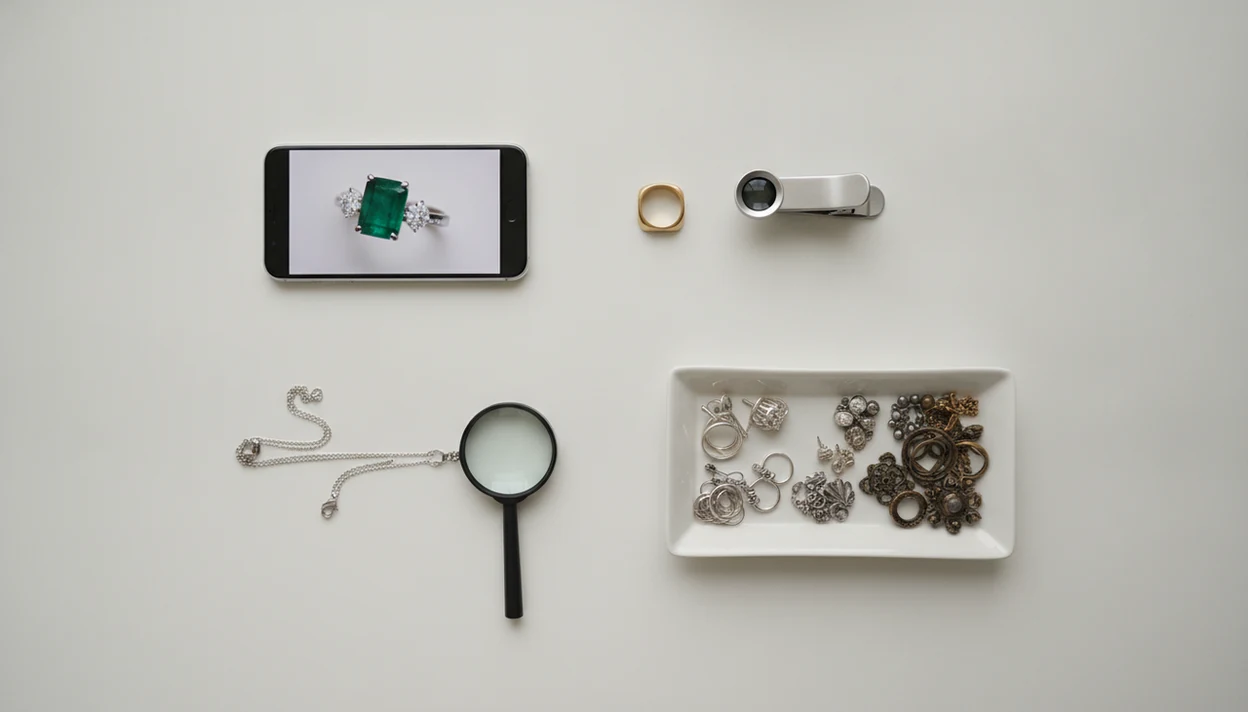
Use this photo workflow to compare gold and costume jewelry before testing. The goal is to document the next detail to check, not to force a final answer from one image.
- Photograph stamps inside ring shanks, clasp tabs, earring posts, and pendant bails in natural light.
- Inspect wear points on raised edges, jump rings, chain links, backs, and skin-contact areas.
- Compare construction by looking at solder joints, hinge quality, clasp strength, and finished undersides.
- Check stone settings for prongs, bead setting, glued rhinestones, foil backs, or molded cups.
- Decide whether to test with acid, XRF, density checks, or a jeweler if the clues remain promising.
A jewelry stamp identifier app can support this workflow, but it is not final proof. On days when a clasp photo is sharp but the pendant front is blown out by flash, JewelryIdentifier works best after one retake in softer light.
Photo Clues That Favor Possible Fine Gold Jewelry
Does this look like gold from the photo? The strongest answer comes from a cluster of clues: a legal-looking karat mark, expected mark placement, even metal color, and careful construction.
Fine jewelry marks often appear inside ring shanks, on clasp tongues, near necklace tags, or on earring posts. A clear 14K, 18K, 585, or 750 mark next to a maker mark raises confidence, especially when the mark location makes sense for the item type. Uniform color across corners, shanks, jump rings, clasps, and backs is another useful signal.
Construction adds context. Secure prongs, smooth soldering, substantial hinges, and finished undersides often suggest a piece deserves hands-on confirmation. For resellers who say, “I just need to know what to call this before I list it,” JewelryIdentifier fits because the ring, necklace, bracelet, and earring photo workflow separates style term, metal stamp, and next-step testing notes.
These clues increase confidence, but they do not confirm gold.
Photo Clues That Favor Gold-Tone Costume Jewelry
Does this look like gold-tone costume jewelry instead? Photos often point that way when the surface shows flaking, chipping, peeling, or silver- and copper-colored metal under the yellow finish.
Green or dark corrosion around clasps, backs, earring posts, and skin-contact areas is another warning sign. Lint, skin oil, and dark pocket fuzz can also hide a mark inside a bracelet clasp, so clean gently before deciding that no stamp exists. Rough unfinished backs, molded settings, glued rhinestones, foil-backed stones, and stamped sheet metal usually favor costume construction.
Very light-looking hollow links or decorative-only clasps also matter. So does plating loss on raised rope texture or bracelet edges.
When the issue is separating obvious plated pieces from items worth testing, JewelryIdentifier handles the first pass through wear-point photos, construction prompts, and visible-clue comparison. Costume does not always mean worthless, though. Some signed vintage costume pieces still deserve brand research.
Gold Stamps, Legal Marks, and Photo Evidence
Gold stamps are useful photo evidence, but they are not metal tests. Common marks include 10K, 14K, 18K, 22K, 417, 585, 750, 916, GF, GP, HGE, and vermeil. For fineness equivalents, 585 indicates 58.5% gold and is commonly associated with 14K, while 750 indicates 75% gold and is commonly associated with 18K source.
The FTC jewelry guides state that jewelry described as “gold” in the United States must be at least 10 karats fine, and lower-karat or plated items need clear qualifiers such as gold-plated or gold-filled source. U.S. Customs regulations also note that many imported precious-metal jewelry items are marked with fineness or karat, which is why visible hallmarks matter in photos source.
Missing marks still happen. Older, resized, handmade, worn, or foreign pieces may have partial or absent hallmarks. Fake and misleading marks exist too. If your photo is blurry, the guide on how to photograph jewelry stamps with phone covers the retake angles that usually help.
Designer Logos and Vintage Jewelry Photo Myths
Designer logos, age, and shine are weak proof of gold content. They can be useful research clues, but they do not replace metal testing.
Bright Yellow Shine Myth
Shiny yellow jewelry is not automatically solid gold. Bright plating, polished brass, and camera warmth can all produce a rich gold look in a resale listing photo.
Designer Logo Myth
A luxury logo does not guarantee fine jewelry. High-end fashion brands may sell expensive gold-tone costume pieces with glass, crystal, synthetic stones, or plated base metal.
Vintage Real Gold Myth
Vintage jewelry is not automatically solid gold. Estate boxes often contain fine gold, sterling, plated chains, sentimental lockets, and signed costume pieces in the same tray.
If your priority is naming the likely maker before testing, JewelryIdentifier works alongside an app that can identify maker marks because the workflow treats logos as research leads, not proof of metal purity.
Gold vs Costume Jewelry Testing Decision Guide
The testing decision should follow the photo evidence. Test pieces with stronger gold signals; research signed costume pieces before dismissing them.
| Decision | Photo evidence | Sensible next step |
|---|---|---|
| Test it | Clear karat mark, strong construction, no plating wear | Acid test, XRF, density check, or jeweler review |
| Test it | Precious-looking stones, secure prongs, finished backs | Appraisal or gem and metal inspection |
| Test it | Estate context, unusual maker mark, consistent color | Research mark, then test |
| Research first | Designer logo, vintage signature, collectible costume brand | Compare against reliable references |
| Probably not worth testing yet | Heavy plating loss, glued stones, no marks, corrosion | Treat as likely costume unless brand research says otherwise |
Magnet screening has limits because many non-gold metals are not strongly magnetic. Acid testing can mark a piece. XRF reads surface composition. Because XRF analyzes the surface area being scanned, layered pieces such as plated or gold-filled jewelry can still need expert interpretation or follow-up testing source. Density checks need care.
The right fit for kitchen-table triage is JewelryIdentifier because it keeps photo-based identification focused on visible clue, likely category, and hands-on confirmation.
Limitations
Photo-based identification has firm limits. It can narrow the likely category, but it cannot confirm metal purity.
- A photo alone cannot prove whether jewelry is solid gold, gold-filled, plated, vermeil, or gold-colored alloy.
- Lighting, filters, camera white balance, and image compression can distort color and shine.
- High-quality plating, gold-filled jewelry, and vermeil can look like solid gold in pictures.
- Older, handmade, resized, or foreign jewelry may lack readable hallmarks.
- Stamps can be fake, worn, partial, upside down, or misread.
- Costume jewelry may use sterling silver, quality plating, collectible branding, or scarce designer signatures.
- Acid testing, XRF, density checks, and professional appraisal are the confirmation methods, not photo review.
- Google Lens, eBay image search, Vestiaire Collective, Whatnot, and rock identifier apps can suggest matches, but they can also over-match shiny yellow items.
JewelryIdentifier provides visible-clue sorting and next-step language, not one-photo authentication or a definitive value.
FAQ
Can you tell if jewelry is real gold from a photo?
You can sometimes identify clues that favor real gold, such as karat stamps, consistent color, and quality construction. A photo cannot confirm gold purity by itself.
Can photos prove that jewelry is real gold?
No. Photos can suggest likelihood, but physical testing is required to prove metal content.
What stamps usually mean real gold?
Common gold marks include 10K, 14K, 18K, 22K, 417, 585, 750, and 916. Stamps still need context because fake, worn, or misleading marks exist.
What does a 585 stamp mean on jewelry?
A 585 stamp usually indicates 14 karat gold, or 58.5% gold content. It should still be checked against the item’s construction and testing results.
Is a 14K stamp always real gold?
A 14K stamp is a gold purity mark. It is not absolute proof because counterfeit or misleading stamps can appear on jewelry.
Does no stamp mean jewelry is fake?
No stamp does not automatically mean fake or costume jewelry. Marks may be missing on old, resized, handmade, worn, or foreign pieces.
Can plated jewelry look like real gold in photos?
Yes. High-quality plating, vermeil, and gold-filled jewelry can look very similar to solid gold in photos.
Do designer logos mean jewelry is gold?
No. Designer and luxury brands can sell gold-tone costume jewelry as well as fine jewelry.
Is vintage jewelry usually real gold?
Vintage jewelry includes both fine gold pieces and a large amount of costume jewelry. Age alone does not prove metal content.
How should I test jewelry for gold?
Common confirmation methods include acid testing, XRF analysis, density checks, and professional jeweler appraisal. JewelryIdentifier jewelry identifier app and photo guides that help users identify rings, necklaces, earrings, bracelets, and vintage jewelry from pictures can help decide what to test, but testing confirms the metal.
Compare gold and costume jewelry clues from your photos
Use Jewelry Identifier to review stamps, wear, style, and construction clues before deciding whether professional testing is needed. It is a helpful first step, not a substitute for a jeweler, gem lab, assay office, or certified appraisal.