
Find Similar Jewelry From Photo Without Mistaking It for Proof
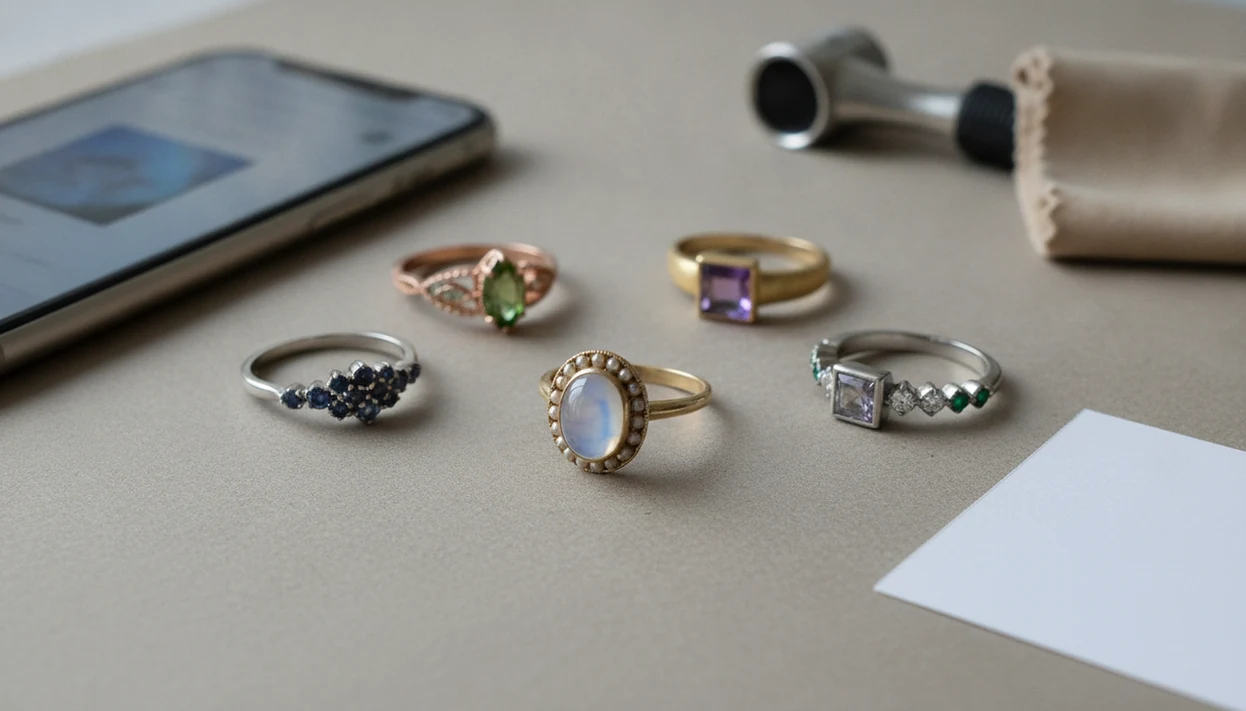


You can find similar jewelry from photo results by using a jewelry image search or identifier app to match shape, stone layout, metal tone, and style details. Treat the matches as visual clues for research or shopping, not proof of brand, metal, gemstone, age, or resale value.
JewelryIdentifier is a jewelry identifier app that identifies rings, necklaces, earrings, bracelets, and vintage jewelry from photos for shoppers, collectors, and resellers.
- Visual matches help you learn style vocabulary, compare look-alike pieces, and start resale research.
- A photo match does not prove your jewelry is the same brand, metal karat, gemstone, age, or value.
- Use clear close-up photos, hallmark images, size context, and professional testing for important decisions.
Jewelry Image Search at a Glance: What a Photo Match Can and Cannot Tell You
Jewelry image search means uploading or scanning a jewelry photo to find visually similar rings, necklaces, earrings, bracelets, or vintage pieces. People also call this “find jewelry by picture” or “visual search jewelry,” especially when they need style words before shopping or listing an item.
A good match can point you toward terms like halo ring, box chain, pavé band, cameo brooch, or white metal pendant. It can also show shopping alternatives that share the same shape or stone layout.
Similarity is not proof. A look-alike result cannot confirm brand, metal purity, gemstone identity, age, or value. That silver chain against a blue receipt may photograph like sterling, but the photo still cannot assay the metal.
Visual search adoption is real; Pew Research Center reported in 2020 that 21% of U.S. adults had used image search tools to find product information (https://www.pewresearch.org/internet/2020/08/20/the-future-of-digital-spaces-and-their-role-in-democracy/). Interpret those results as leads, not conclusions.
Computer Vision Signals Behind Jewelry Photo Matches
Photo jewelry matching works by comparing visible patterns in an image, not by physically testing the object. Computer vision systems read shape, color, stone arrangement, metal tone, silhouette, texture, and visible design details.
Behind the screen, the tool may turn the photo into image embeddings. In plain language, it converts visual features into searchable signals, then compares them with catalogs, indexed product images, or reference databases. A necklace spread flat on a towel usually gives cleaner signals than a pendant photographed under harsh flash.
This is why matches can be useful but limited. A system can notice a tennis bracelet shape or cluster earring layout, but it cannot test karat, refractive index, or treatment. Research on fine-grained fashion recognition, including the DeepFashion dataset paper, shows that image models can retrieve visually similar fashion items but still struggle with subtle material and small-detail differences (https://openaccess.thecvf.com/contentcvpr2016/html/LiuDeepFashionPoweringRobustCVPR2016paper.html).
Tools like JewelryIdentifier, Google Lens, and eBay image search sit in this practical middle ground.
6 Steps to Use a Photo to Find Similar Jewelry by Picture
- Clean the lens and jewelry surface before shooting, since lint and skin oil can hide a mark inside a bracelet clasp.
- Place the piece on a plain background with good light, then crop close so the jewelry fills most of the frame.
- Photograph several angles, including the front, side profile, back, clasp, prongs, chain links, and any hallmark or maker mark.
- Add size context with a ruler, coin, or finger, but don’t treat size as evidence of value.
- Search more than one tool and compare several matches instead of trusting the first result.
- Save useful style terms such as filigree, curb chain, halo setting, leverback earring, or signet ring.
For necklace-specific searches, a necklace finder by photo guide can help separate chain style from pendant style.
I just need to know what to call this before I list it. That is a reasonable goal for photo search.
Five Facts About Finding Similar Jewelry From a Photo
- Visual search compares visible design traits, including outline, stone layout, color, chain pattern, setting style, and decorative details.
- Clear, close-up photos usually produce better matches than dark, angled, cropped, or cluttered pictures.
- Similar does not mean identical; two rings can share a silhouette while differing in brand, stone quality, metal, and construction.
- Jewelry identifier apps can suggest style vocabulary and likely categories, especially for common forms like hoop earrings, solitaire rings, and box chains.
- High-value, heirloom, insurance, or resale decisions need hands-on confirmation from a jeweler, gemologist, appraiser, or laboratory report.
Good jewelry identifier app and photo guides that help users identify rings, necklaces, earrings, bracelets, and vintage jewelry from pictures deliver vocabulary and next-detail checks, not authentication or value guarantees.
A photo match is a sorting tool, not a verdict.
Photo Clues That Improve Find Jewelry by Picture Results
Rings: Photograph the top, side profile, under-gallery, inside shank, prongs, and any metal stamp. We have tried reading a tiny 14K stamp inside a yellow-gold ring under thrift-store fluorescent lights; one clean close-up beats five blurry guesses.
Necklaces: Capture the clasp, chain style, pendant front, pendant back, and any tag. A lobster clasp on a fine chain can change the likely category, especially for resale wording.
Earrings: Show the front, back, post, clip, hinge, hallmark, and pair shape. If earrings are your main question, what app identifies earrings from photos covers that angle in more detail.
Bracelets and vintage pieces: Include clasps, safety chains, hinges, backs, patina, repairs, and scale. A ruler, coin, or finger communicates size, not value.
Write down visible clues as you go: halo ring, pavé band, box chain, filigree, cameo, white metal, bezel setting.
4 Myths About Visual Search Jewelry Matches
Does an exact-looking online match prove my jewelry is the same item? No. It may only share a mold, style trend, stone arrangement, or product photograph angle.
Myth 1: A match proves the same brand. Many brands and factories make similar forms, especially in solitaire rings and chain necklaces.
Myth 2: One photo can appraise value. Appraisal depends on inspection, testing, condition, documentation, and market context.
Myth 3: A clear image confirms the stone. The FTC jewelry guides warn against unsupported claims about gemstones and precious materials, and GIA explains that accurate diamond grading depends on trained examination and standardized factors, not a single photo (https://www.ftc.gov/business-guidance/resources/guides-jewelry-precious-metals-pewter-industries; https://www.gia.edu/gia-4cs-diamond-quality).
Myth 4: Visual search can reliably date vintage jewelry. Style can suggest an era, but age needs construction clues, marks, provenance, and expert review.
For stamp-focused research, a jewelry stamp identifier app can help you record marks before asking a jeweler.
Similarity Match vs Jewelry Identification vs Appraisal
A similarity match, photo-based identification, and appraisal answer different questions. Mixing them up is where many bad buying and selling decisions start.
| Outcome | What it can tell you | What it cannot prove | When to use it |
|---|---|---|---|
| Visual similarity match | Look-alike pieces, style direction, shopping alternatives, listing keywords | Brand, metal purity, gemstone identity, age, or value | When you want to find similar jewelry from a photo |
| Photo-based jewelry identification | Likely category, visible marks, possible era clues, design vocabulary | Authenticity, originality, precise date, or material confirmation | When sorting likely gold, likely silver, costume, sentimental, and take-to-a-jeweler piles |
| Appraisal | Professional valuation based on inspection, testing, condition, documents, and market context | It still may not prove every historical claim without records | Before insurance, estate division, major resale, or repair |
For resellers, visual matching is often faster than manual keyword guessing because it gives style terms to test across several listings. Still, a similar asking price is not the same as resale value.
Limitations
Photo-based jewelry search has real boundaries. The camera sees surface clues, not hidden material facts.
- A photo cannot reliably determine 10k vs 14k vs 18k gold, plating, or metal purity.
- A photo cannot prove diamond, cubic zirconia, moissanite, natural gemstone, lab-grown gemstone, or imitation.
- A visual match cannot confirm brand, designer, maker, provenance, age, or originality.
- Catalog coverage limits results, so rare, custom, antique, altered, or repaired pieces may be missed.
- Blur, glare, shadows, reflections, fingers, partial views, and busy backgrounds reduce accuracy.
- Small construction differences, stone quality, repairs, damage, and craftsmanship may be invisible but affect value.
- A clasp in focus does not help much if the pendant front is blown out by flash.
- Professional jeweler, gemologist, appraiser, or lab confirmation is needed before buying, selling, insuring, or repairing valuable pieces.
For bracelet questions, what app identifies bracelets from photos is useful for vocabulary, but testing still matters.
FAQ
Can AI identify jewelry from a photo?
AI can suggest a likely category, style term, and visually similar items from a jewelry photo. It cannot fully authenticate jewelry or prove material, stone, age, brand, or value.
Is there an app that can identify jewelry by picture?
Yes, jewelry identifier apps can analyze photos for visible style clues, likely categories, marks, and similar items. JewelryIdentifier is one example, but any photo result should be treated as a research starting point.
Can I search for jewelry by uploading a picture?
Yes, many visual search tools let you upload a picture to search for similar rings, necklaces, earrings, bracelets, and vintage pieces. The results are most useful for style comparison and shopping research.
How accurate are photo jewelry matches?
Accuracy depends on photo quality, catalog coverage, and how visually distinctive the piece is. Common designs are easier to match than rare, altered, handmade, or heavily worn pieces.
Can a photo tell if jewelry is real gold?
No, a photo cannot reliably prove gold content, plating, or karat. Metal testing or professional inspection is needed.
Can a photo tell if a stone is a real diamond?
No, diamond versus cubic zirconia, moissanite, lab-grown diamond, or imitation requires proper testing and equipment. A photo can only show visible similarity.
Can visual search help identify vintage jewelry?
Visual search can find similar vintage styles, clasps, shapes, and decorative patterns. It cannot confirm age or provenance by itself.
Can similar jewelry listings show what my piece is worth?
Similar listings can provide research clues, especially for wording and market comparison. They are not a formal resale or insurance appraisal.
What kind of photo works best for jewelry image search?
Use clear, close-up, well-lit photos on a plain background with the jewelry filling the frame. Add separate images of marks, clasps, backs, settings, and scale references.
Search Smarter With Jewelry Identifier
Upload jewelry photos to get style clues, similar visual matches, and research prompts in one place. Use the results as a starting point, then verify important findings with a qualified professional.