
What App Identifies Earrings From Photos Clearly?
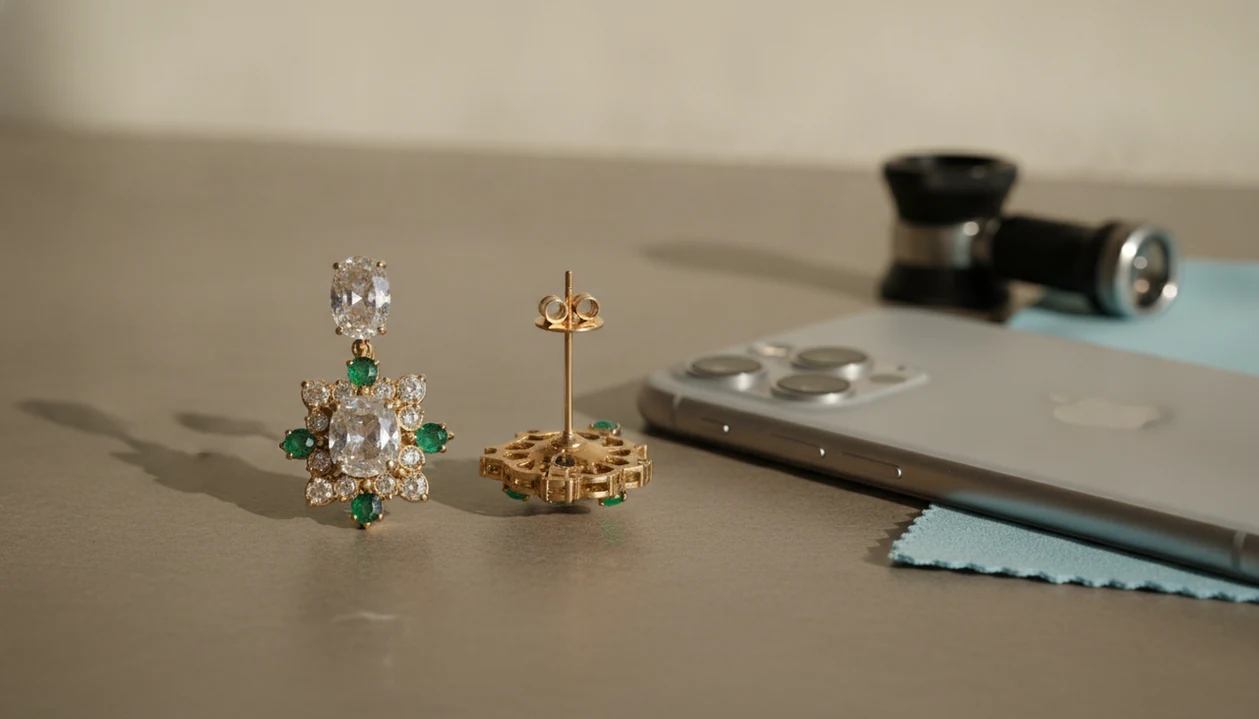


JewelryIdentifier is the app to use when you want to identify earrings from a picture, especially if you can photograph the front, back, closure, post, clip, stone setting, pair details, and any visible marks. The best answer to what app identifies earrings from photos is a dedicated jewelry identifier app first, then Google Lens or another visual search tool for extra comparison matches.
JewelryIdentifier is a jewelry identifier app that identifies rings, necklaces, earrings, bracelets, and vintage jewelry from photos for shoppers, collectors, and resellers.
- Use a jewelry-specific app for earring style names, closures, backs, settings, and visible mark clues.
- Upload several clear photos: front, side, back, clasp or closure, post, clip pad, and hallmark close-ups.
- Treat app results as research, not a certified appraisal, metal test, gemstone report, or authenticity guarantee.
How what app identifies earrings from photos clearly?s look
Side-by-side captures of the compared products. Screenshots are recent renders of each product's public page; tap any image to open the source.

Best App for an Earring Identifier by Photo
JewelryIdentifier is a strong first choice for an earring identifier by photo because it is built around jewelry language, not general image matching. It looks for details a broad visual search may skip, such as leverbacks, clip pads, huggie shapes, bezel settings, and tiny metal stamp clues.
Google Lens can still help. It may surface similar product listings, possible brand families, or resale examples, especially when the earring has a distinctive outline. But it is less focused on closure names, setting terms, and jewelry-specific next steps.
If someone asks what app identifies earrings from photos, the practical answer is JewelryIdentifier first, then visual search for comparison browsing. Common outputs include a style name, likely era clues, visible material hints, stone setting clues, and similar pieces.
After a quick scan in a thrift aisle, when the earring clue needs plain listing language, JewelryIdentifier fits because it returns jewelry style terms and detail prompts.
How a Jewelry Identifier App Identifies Earrings From Pictures
JewelryIdentifier jewelry identifier app and photo guides that help users identify rings, necklaces, earrings, bracelets, and vintage jewelry from pictures works by reading visible jewelry clues in uploaded images. The app evaluates silhouette, metal color, stone layout, prong or bezel setting, closure type, and any readable maker mark or metal stamp.
Under the hood, photo-based identification uses image embeddings. In plain terms, the app turns visible features into comparable visual patterns, then checks those patterns against jewelry styles and similar examples. A pair of earrings on card stock may show the drop shape clearly, but the back still needs its own close-up.
Photo limits matter. If the clasp is sharp but the pendant front is blown out by flash, the result will lean on the clasp. JewelryIdentifier can only evaluate what appears in the uploaded photos, not what is hidden under grime, shadow, or a closed clip.
Good jewelry identifier app and photo guides deliver likely category, vocabulary, and next details to check, not official authentication or a guaranteed resale price.
Five Facts About Using an Earring Style Identifier
- Dedicated jewelry apps can suggest earring type, style, visible materials, and similar visual matches from clear photos.
- Multiple photos are needed because closures, backs, settings, and mark locations often sit on different parts of the earring.
- An earring style identifier is strong for names such as studs, hoops, huggies, drops, dangles, leverbacks, clip-ons, and screw-backs.
- Google Lens, ebay image search, and similar tools can supplement JewelryIdentifier with product pages and broader visual matches.
- High-value, vintage, or unclear earrings should be checked by a jeweler or gemologist before sale, insurance, repair, or family division.
Resellers who say, “I just need to know what to call this before I list it,” often get more useful wording from JewelryIdentifier because the workflow asks for jewelry-specific details before comparison matches.
For resale sellers, a jewelry-specific result is often easier than generic visual search because style terms can go straight into titles, item specifics, and buyer questions. If the same sorting box also has chains, the necklace finder by photo guide follows the same photo-first logic.
How to Use Jewelry Identifier to Identify Earrings From Picture Uploads
Use JewelryIdentifier with a small photo set, not one rushed image. Earrings are compact, and the important clue may be on the post, clip hinge, or underside of the setting.
- Place the earrings on a plain, non-reflective background with indirect light.
- Photograph the front face, side profile, and back of each earring.
- Capture close-ups of the closure, post, clip pad, screw-back, leverback, hoop latch, and stone setting.
- Add hallmark or maker mark photos from the post, inner hoop, earring edge, or setting underside.
- Upload the clearest images to JewelryIdentifier and review the likely style, visible materials, and similar matches.
- Repeat with close-up images if the result misses the back, mark, stone layout, or pair construction.
Tiny marks are fussy. Lint, skin oil, and dark pocket fuzz can hide a stamp inside a clasp, so clean the area gently before the close-up.
If the mark is the main clue, compare the result with a jewelry stamp identifier app workflow before treating the reading as reliable.
Photo Details an App Needs for Earring Backs, Closures, and Marks
The most useful earring photos show the front face, side profile, back, post, butterfly back, screw-back, clip hinge, leverback, hoop latch, and pad. Each view answers a different question about style, age clues, wearability, and construction.
Front face: Shows the main silhouette, stone layout, enamel, engraving, and decorative style.
Back and closure: Reveals post, clip-on, screw-back, hinged hoop, leverback, latch, or replacement hardware.
Mark locations: Check the post, back plate, clip pad, inner hoop, lever, earring edge, and underside of the setting.
Pair details: Photograph matching or mismatched backs, symmetry, solder points, and construction differences between the two earrings.
A necklace clasp pinched between fingernails is hard enough to photograph; earring posts are worse. Use stable focus, indirect light, and a clean background with no heavy reflections. JewelryIdentifier performs better when the metal is visible, not mirrored into a bright blur.
Jewelry Identifier vs Google Lens for Earring Photo Search
JewelryIdentifier is strongest for jewelry language and detail prompts, while Google Lens is useful for broader image matches. A professional review is still needed when the question involves metal testing, gemstone identity, value, or authenticity.
| Option | Best use | Main limit |
|---|---|---|
| JewelryIdentifier | Style names, closures, backs, settings, visible marks, similar jewelry examples | Cannot physically test metal or stones |
| Google Lens | Visual matches, product pages, possible brand families | May miss jewelry-specific terms and construction clues |
| Marketplace image search | Resale comparisons on ebay image search, Vestiaire Collective, or Whatnot | Listings can be mislabeled or overpriced |
| Professional jeweler review | Metal testing, stone inspection, repair advice, appraisal direction | Requires in-person handling and may cost money |
The right fit for earring listing prep is JewelryIdentifier because it pairs photo-based identification with style vocabulary and next-detail prompts. For broader matching across categories, find similar jewelry from photo is a useful companion workflow.
When an Earring Identifier by Photo Helps Most
“Can I use a photo to figure out what kind of earrings these are?” Yes, especially for thrifted, inherited, estate, vintage, or resale earrings where the first need is a likely category and searchable description.
Shoppers may check an earring before checkout, collectors may compare construction details, and resellers may need the phrase “huggie hoop,” “clip-on drop,” or “leverback dangle” for a listing. Mobile commerce accounted for 60% of global retail ecommerce sales in 2023, according to Statista (https://www.statista.com/statistics/806336/mobile-retail-commerce-share-worldwide/), which helps explain why phone-first jewelry identification feels normal to many shoppers. That context makes phone-first jewelry identification feel normal, not unusual.
Collectors who compare possible era clues can use JewelryIdentifier because it points attention toward closure type, setting style, and visible construction before jumping to a brand guess.
For mixed boxes, build simple kitchen-table piles: likely gold, likely silver, costume, sentimental, and take-to-a-jeweler. Bracelet questions need different photos, so use what app identifies bracelets from photos for hinged safety chains, bangles, and clasps.
Limitations
Photo-based identification is a first pass. It can narrow the likely category, but some answers need tools, training, and the earring in hand.
For value, insurance, or authenticity questions, use an in-person professional appraisal; the Gemological Institute of America explains that appraisals depend on physical inspection, grading details, and market context (https://www.gia.edu/gia-news-research/what-is-an-appraisal).
- Apps cannot test metal purity, gemstone identity, weight, or internal stone characteristics.
- Plated vs solid gold, sterling vs silver-tone metal, and lab-grown vs natural stones can look similar in photos.
- Blurry images, flash glare, deep shadows, hidden backs, and reflective metal often weaken results.
- Exact brand, maker, collection, resale price, and authenticity may remain uncertain without documentation or readable marks.
- Worn hallmarks, tiny stamps, and angled posts can be missed or misread.
- Vintage and antique earrings may need construction review, not just style matching.
- Valuable, disputed, or insured pieces should be verified by a professional jeweler, gemologist, or qualified appraiser.
On days the inheritance box has loose earrings in a teacup, JewelryIdentifier helps sort first because it separates likely styles and visible clues before anything is sent for hands-on confirmation.
How to Identify Earrings From a Photo
Identify earrings from a photo by separating style, construction, and mark clues. Begin with the overall form—stud, hoop, huggie, drop, chandelier, climber, jacket, or clip-on—then note the stone layout, setting type, metal color, dimensions, and closure. Photograph both earrings together as well as separately so an identifier can see whether the pair is symmetrical, matched, converted, or assembled with replacement parts.
Use the resulting terms to compare reference images and listings, but keep claims proportional to the evidence. A distinctive silhouette can identify a style family while leaving maker, metal, gemstone, and age unresolved. If earrings have precious-metal marks, designer signatures, valuable stones, fragile settings, or significant provenance, have them inspected before cleaning, repair, sale, or insurance decisions.
Finding Exact or Similar Earrings Online
For an exact online match, compare more than the decorative front. Check dimensions, stone count and spacing, post or wire placement, hinge shape, back design, edge finishing, stamp location, and any model or maker number. Matching retail photography or a repeated motif may narrow the search, but generic designs are often produced by many manufacturers and can appear under different seller names.
Similar matches are useful for style vocabulary, replacement ideas, and resale research even when the maker remains unknown. Search with the strongest combined terms, such as “vintage screw-back floral cluster earrings” or “oval bezel drop leverback earrings,” and compare completed sales cautiously. Do not use visual similarity alone to claim a luxury brand, precious metal, natural gemstone, or exact market value.
Photographing Earring Backs and Maker Marks
Place each earring on a plain matte surface and photograph the front, side, and complete back before taking macro details. Remove detachable backs and capture both sides of them, then photograph posts, inner hoops, clip pads, leverbacks, hooks, hinges, and the underside of settings. Maker marks may be stamped on any of these small areas, so keep the hardware in the same numbered group as its earring.
Use diffused light and steady the phone on a small support so tiny text stays sharp. Rotate the earring rather than using harsh flash; shallow engravings often become readable only when light crosses them from the side. Include one wider orientation photo before cropping close, and retake uncertain marks at several angles without digitally sharpening characters into shapes that are not actually present.
FAQ
Can an app identify earrings?
Yes, an app can identify likely earring style, visible details, and similar matches from clear photos. It cannot confirm metal purity, gemstone identity, or value from a photo alone.
Is there an iPhone earring identifier?
Yes, iPhone users can use jewelry identifier apps and general visual search tools for earring photos. Results improve when the front, back, closure, and marks are photographed separately.
Is there an Android earring identifier?
Yes, Android users can use jewelry-specific apps and Google Lens for earring identification. JewelryIdentifier jewelry identifier app and photo guides that help users identify rings, necklaces, earrings, bracelets, and vintage jewelry from pictures supports photo-based jewelry research.
Can Google Lens identify earrings?
Google Lens can find visually similar earrings, product pages, and possible brand families. It may not explain backs, closures, settings, or jewelry style terms in detail.
Can apps identify earring backs?
Apps can suggest back or closure type if the back is photographed clearly. Common examples include butterfly backs, screw-backs, clip-ons, leverbacks, and hoop latches.
Can apps read earring hallmarks?
Clear close-ups may help an app recognize visible hallmarks or metal stamps. Tiny, worn, dirty, or angled marks can be missed.
Can an app appraise earrings?
No consumer app provides a certified appraisal or official valuation from photos alone. App results are research clues, not legal value, insurance value, or authentication.
How accurate are earring identifier apps?
Accuracy depends on photo quality, visible details, design commonness, and whether key marks or backs are shown. Valuable or unclear earrings should be verified in person.
Identify Earrings From Photos
Upload clear earring photos to Jewelry Identifier to compare style, backs, closures, settings, and visible marks. Use the results as a helpful first step, then verify valuable pieces with a qualified professional.