
Tool That Can Read Jewelry Hallmarks From Close-Up Photos
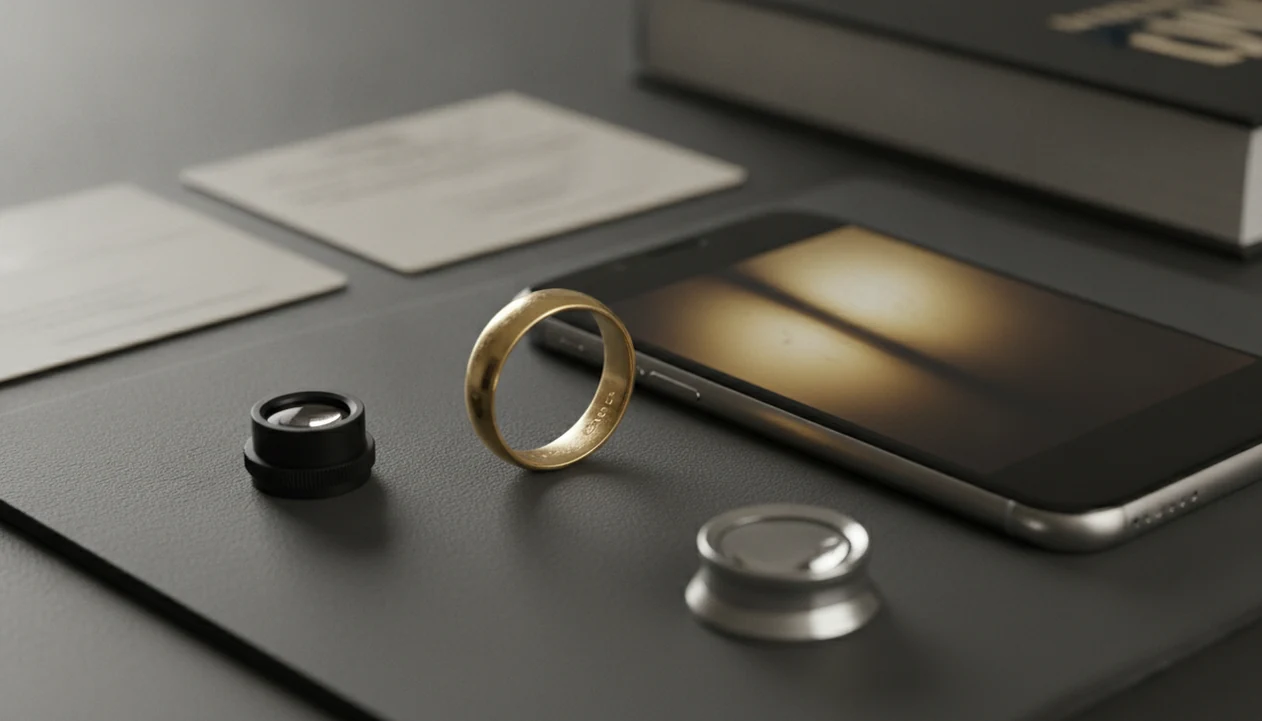


A tool that can read jewelry hallmarks can suggest what a stamp may mean from a sharp close-up photo, but it cannot prove metal purity, authenticity, or value by itself. Use it to compare marks, numbers, symbols, and jewelry context against references, then confirm important claims with a jeweler, assay office, or XRF testing.
> A jewelry hallmark reader by photo is an app or online tool that analyzes close photos of tiny jewelry stamps and compares them with hallmark, maker mark, metal fineness, country, and period references.
- Photograph the hallmark close up, then photograph the entire ring, necklace, bracelet, earrings, or vintage piece for context.
- Treat app matches as likely interpretations, not proof of gold, silver, platinum, authenticity, or resale value.
- Cross-check numeric marks, maker marks, assay symbols, date letters, and reference sources before making any metal claim.
What a Tool That Can Read Jewelry Hallmarks Actually Identifies
A tool that can read jewelry hallmarks identifies visible clues in a stamp, not the physical metal inside the piece. It reads shapes, numbers, letters, assay symbols, maker marks, and stamp placement from close-up photos.
A good result may suggest a likely country, maker, assay office, period, or nominal fineness. For example, a clear “750” inside a ring shank may point toward 18K gold standards in many systems. Still, that is a claimed mark, not a lab result.
We have tried reading a tiny 14K stamp inside a yellow-gold ring under thrift-store fluorescent lights. The mark looked clear to the eye, then turned into a soft gold blur on the phone.
Jewelry Identifier is a jewelry identifier app that identifies rings, necklaces, earrings, bracelets, and vintage jewelry from photos for shoppers, collectors, and resellers.
Before You Start: What You Need to Read Jewelry Hallmarks
Before you start, set up for a sharp, honest photo of the mark rather than trying to make the jewelry look polished. You need magnification, gentle light, steady support, and a plan for pieces where the result could affect resale or insurance claims.
- Gather a phone with macro mode, or add a clip-on macro lens if the stamp is too small for a normal close-up.
- Place the jewelry on a steady surface over a clean cloth so it does not slide, scratch, or pick up lint while you shoot.
- Use soft side lighting instead of direct flash, moving the light until shallow letters cast enough shadow to read.
- Wipe lightly with a dry soft cloth, but do not use abrasive polish before photographing worn, shallow, or partial marks.
- Check each photo with a loupe nearby, comparing the screen crop with the actual letters before you accept the image.
- Set aside high-value, antique, inherited, or resale pieces for jeweler confirmation before making metal, maker, or price claims.
Photo Requirements for a Hallmark Reader by Photo
A hallmark reader by photo needs more than one close crop because the mark and the object explain each other. The next detail to check is often outside the stamp itself.
- Photograph the mark straight on, close enough to show each edge of the stamp.
- Add an angled shot, since shallow marks often appear only when side light catches them.
- Include a full-piece photo of the ring, necklace, bracelet, earrings, or vintage item.
- Capture the clasp, ring shank, pendant bail, earring post, bracelet tongue, or case back.
- Shoot any extra stamps, maker marks, patent marks, or country marks separately.
Use steady support, soft side lighting, and a crop that keeps the mark sharp. Avoid flash on polished metal when possible. We often see phone photos where the clasp is in focus but the pendant front is blown out by flash.
The whole piece matters because era, construction, clasp type, and style term can rule matches in or out. For more setup detail, use a guide on how to photograph jewelry stamps with phone.
How a Jewelry Hallmark Scanner Works Behind the Photo
A jewelry hallmark scanner works by turning a close photo into searchable visual data. The usual process includes crop detection, contrast enhancement, character recognition, symbol recognition, and database matching.
In plain terms, the tool tries to make the stamp easier to read, then compares its shape to known references. Image recognition may look for “925,” “14K,” an anchor, a date letter, a shield outline, or a maker’s initials. Better systems do not read one stamp in isolation. They compare the mark with the whole piece, including clasp style, stone setting, construction, and likely period.
A brooch pinned to black velvet may give different context than the same mark on a modern charm bracelet. Small details matter.
Reference sources can include hallmark books, assay references, museum records, auction databases, and maker mark libraries. Photo-based identification gives useful vocabulary, not final authentication. JewelryIdentifier combines a jewelry identifier app and photo guides that help users identify rings, necklaces, earrings, bracelets, and vintage jewelry from pictures, but it should deliver likely categories and next checks, not guaranteed purity or value.
How to Use a Tool That Can Read Jewelry Hallmarks
Use a tool that can read jewelry hallmarks as a structured research step, not as the final word. The safest workflow keeps the photo match, the visible clue, and the uncertainty note together.
- Clean gently with a dry soft cloth, avoiding harsh polishing that can erase shallow marks.
- Shoot the mark close up with side light, macro mode, and the jewelry resting still.
- Add full-piece photos showing the ring, chain, clasp, bracelet hinge, earring back, or pendant front.
- Review likely matches and compare the mark shape, numbers, letters, and placement.
- Check references before repeating a metal, maker, country, or period claim.
- Save uncertainty notes such as “possibly 585,” “mark worn,” or “needs jeweler confirmation.”
Tools like JewelryIdentifier can help organize the likely category and next detail to check, especially when you are sorting mixed pieces. Do not turn a photo match into a guaranteed gold, platinum, sterling, antique, or maker claim.
Step 1: Capture Clear Crops for Read Jewelry Marks Online Searches
Where do you photograph jewelry hallmarks for read jewelry marks online searches? Start with ring shanks, necklace clasps, pendant bails, earring posts, bracelet tongues, watch case backs, and the backs of brooches or charms.
Use macro mode if your phone has it. Rest the piece on a steady surface, then bring in side lighting instead of direct glare. Take several angles before you decide the mark is unreadable. A macro shot of a maker mark often needs two or three tries, especially when the stamp sits inside a curved ring or near a hinge.
Don’t scrub first. Lint, skin oil, and dark pocket fuzz can hide a mark inside a bracelet clasp, but aggressive cleaning can also make a weak stamp worse. Soft cloth first. Nothing gritty.
Worn, partial, polished, or distorted marks may stay unreadable even with good photos. If the issue is maker initials rather than fineness, an app that can identify maker marks may be the more focused next step.
Step 2: Cross-Check Hallmark Reader by Photo Results Against References
A hallmark reader by photo result is strongest when several marks agree. One stamp can mislead, especially on repaired, plated, imported, or copied jewelry.
- Hallmarks may encode country, assay office, date letter, maker mark, and nominal metal fineness.
- UK gold fineness standards include numbers such as 375, 585, 750, 916, and 999 parts per thousand, as reflected in UK hallmarking guidance (https://www.gov.uk/guidance/hallmarking-guidance-notes).
- In the United States, FTC Jewelry Guides require quality marks such as 14K to accurately represent fineness and be paired with maker identification under 16 CFR Part 23 (https://www.ecfr.gov/current/title-16/chapter-I/subchapter-B/part-23).
- A maker mark should fit the object’s construction, period, and likely market, not just the letter shape.
- A full-piece comparison can catch mismatches, such as an old-looking mark on a newly made clasp.
For inherited boxes, we usually sort at the kitchen table into likely gold, likely silver, costume, sentimental, and take-to-a-jeweler piles. For resellers, cross-checking is often easier than guessing because each listing needs a defensible description. A free jewelry stamp identifier app can help with the first pass, but references still matter.
Common Myths About a Jewelry Hallmark Scanner
A jewelry hallmark scanner can narrow the likely interpretation of a visible mark, but it cannot remove every doubt. Most mistakes happen when a useful clue gets treated as proof.
Myth one: a recognized hallmark proves real gold, silver, or platinum. It does not. Marks can be wrong, copied, worn, transferred during repair, or stamped on plated material.
Myth two: a hallmark match proves market value. Value depends on metal content, condition, maker demand, design, stones, provenance, and timing. A scratched bangle with a readable stamp is still a scratched bangle.
Myth three: all real jewelry must have a clear hallmark. Some legitimate pieces lack marks because of age, size, wear, country rules, or later repairs.
Myth four: AI can always identify obscure, damaged, or worn maker marks. It can’t. A broken clasp caught in lace or a half-polished stamp may leave too little to compare.
Photo identification usually works best when the mark is clear and the whole item supports the same story, while professional review fits pieces where money or legal claims are involved.
Metal Claims After a Tool That Can Read Jewelry Hallmarks
Visual hallmark reading is research, not proof of elemental composition. A photo can show what a stamp appears to say, but it cannot measure gold, silver, platinum, base metal, plating, solder, or repairs beneath the surface.
| Claim type | What a photo tool can say | What confirms it |
|---|---|---|
| “Marked 14K” | The stamp appears to read 14K | Jeweler review, assay, or XRF testing |
| “Likely sterling” | A visible 925 or sterling mark is present | Metal testing and context checks |
| “Antique gold” | Style and marks may suggest age and fineness | Appraiser review plus testing |
| “Designer piece” | Maker mark may resemble a known mark | Brand expertise, provenance, and inspection |
| “Resale value” | Comparable terms may help research | Market comps, condition review, and appraisal |
X-ray fluorescence, often called XRF, is a non-destructive technique used to determine elemental composition in materials, including metals (https://www.britannica.com/science/X-ray-fluorescence). That is why visual matches cannot verify metal content. Deceptive or inaccurate precious metal claims are legally risky under FTC Jewelry Guides, especially in resale descriptions.
If you are weighing gold vs costume jewelry from photos, treat the photo result as a sorting clue. High-value, antique, inherited, or resale jewelry deserves hands-on confirmation.
Limitations
Photo-based hallmark reading has real limits. Some are technical, and some come from jewelry history itself.
- A photo tool cannot prove actual metal content, authenticity, gemstone identity, maker attribution, or appraisal value.
- Blur, glare, low contrast, curved metal, and shallow depth of field can change what a stamp appears to say.
- Wear, polishing, resizing, solder repairs, and partial stamping can remove key letters or symbols.
- Databases are incomplete, especially for small workshops, defunct makers, regional marks, and older costume jewelry.
- Counterfeit or misleading marks can resemble legitimate hallmarks in photos.
- Regional hallmarking rules vary, so the same number or symbol may need country context.
- Very small marks inside clasps, bails, and ring shanks may distort in phone crops.
- High-value pieces should be reviewed by a jeweler, assay office, or qualified appraiser.
A tray of mixed costume rings can still produce one exciting mark. Slow down anyway. For older styles, a vintage jewelry identifier by photo can help with era clues before you decide what needs testing.
FAQ
What reads jewelry hallmarks?
Jewelers read hallmarks with loupes, microscopes, reference guides, hallmark databases, and sometimes photo-based hallmark tools. A tool can help identify visible marks, but expert review is still needed for important claims.
Can an app read hallmarks?
Yes, an app can suggest likely hallmark matches from clear close-up photos. It cannot guarantee the result or prove metal purity.
Can hallmarks prove real gold?
Hallmarks can indicate claimed fineness, such as 14K or 750. Testing is needed to prove actual metal content.
What does 750 mean on jewelry?
750 usually means 750 parts per thousand gold, commonly equivalent to 18K. The mark still needs context and authenticity checks.
Where are hallmarks on rings?
Ring hallmarks are commonly inside the shank. They may appear near a maker mark, fineness stamp, assay symbol, or date letter.
Why is my jewelry hallmark unreadable?
A hallmark may be unreadable because of wear, polishing, shallow stamping, dirt, glare, blur, or partial marking. Better lighting helps, but some marks remain too damaged.
Do all jewelry pieces have hallmarks?
No, legitimate jewelry may lack hallmarks because of age, wear, small size, country rules, or repairs. Lack of a mark does not prove costume jewelry.
Are online hallmark readers accurate?
Online hallmark readers can be useful when photos are sharp, marks are intact, and reference coverage is strong. Accuracy drops with worn marks, glare, obscure makers, and poor context.
What confirms jewelry metal content?
Professional testing such as assay or XRF confirms elemental composition. Hallmark tools, including JewelryIdentifier, help with identification but do not prove metal purity.
Read Jewelry Hallmarks With Better Photo Clues
Use Jewelry Identifier to capture hallmark details, compare stamp clues, and organize what to verify next. Always confirm valuable pieces with a qualified jeweler or appraiser before buying, selling, or insuring.