
Check If Jewelry Is Sterling From Photo Clues
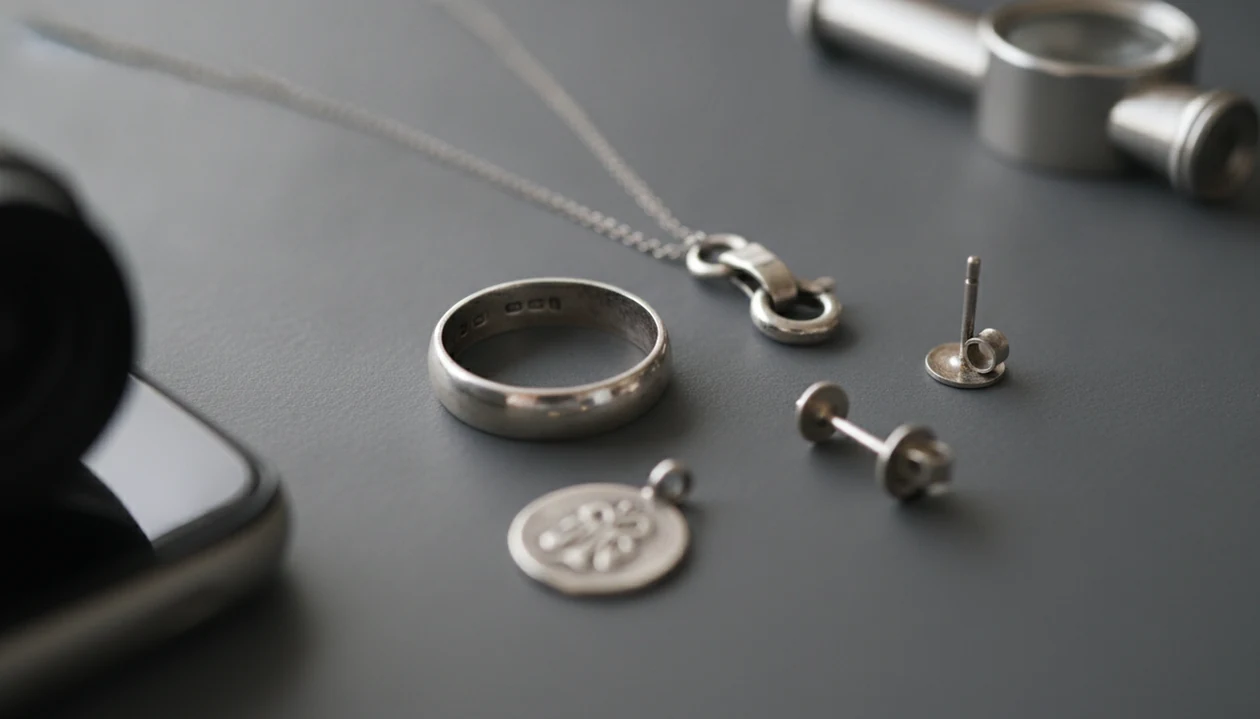


You can check if jewelry is sterling from photo clues by looking for a 925 or sterling mark, gray-black tarnish, plating wear, clasp stamps, and construction details, but a photo cannot prove silver purity. Treat the image as a screening step, then confirm with a jeweler, safe test kit, or other physical verification.
> Definition: A sterling silver photo check is a visual review of jewelry images for marks, wear, tarnish, and construction clues that suggest sterling silver before physical testing confirms the metal.
TL;DR
- A visible 925, STERLING, 925 Italy, or similar stamp is the strongest photo clue, but stamps can be copied or misleading.
- No visible stamp does not automatically mean fake because antique, handmade, repaired, or worn jewelry may have hidden or missing marks.
- Photo clues can narrow the answer, but magnet, acid, density, or professional testing is needed to confirm sterling silver.
Can a Photo Show Sterling Silver With Confidence?
can a photo show sterling silver? A photo can show likely sterling clues, but it cannot prove that a piece contains 92.5% silver. That answer requires physical testing, not image review.
The strongest photo clues are a readable 925 or STERLING stamp, natural gray-black tarnish, and wear that does not reveal coppery or brassy base metal. Still, lighting, resolution, angle, glare, editing, and hidden marks can all change the result. We have seen photos where the clasp is sharp, but the pendant front is blown out by flash. Useful, but incomplete.
Photo review works best as the first screening step before testing. For a reseller, photo clues are often easier than guessing from color because stamps, wear points, and construction details give specific next checks.
Five 925 Jewelry Photo Facts That Matter Most
- 925 means sterling composition. Sterling silver is typically 92.5% silver and 7.5% other metals, which is why 925 appears on many rings, chains, charms, and earrings; the FTC describes sterling silver as at least 925 parts per thousand pure silver: https://www.ecfr.gov/current/title-16/chapter-I/subchapter-B/part-23.
- A clear stamp is strong evidence, not proof. A sharp 925,.925, or STERLING mark in a photo is the best visual clue, but stamps can be copied, altered, or placed on only one component.
- Plating wear matters. Coppery, brassy, dark base-metal color, peeling, flaking, or rubbed high points argue against solid sterling.
- Missing marks do not end the question. Vintage, handmade, imported, repaired, resized, or heavily worn jewelry may have no visible stamp in the photo.
- Testing confirms the guess. Magnet response, acid testing, density clues, or jeweler inspection is needed before calling an item sterling with confidence.
A bracelet laid beside a coin can help show scale, but it still cannot show metal chemistry. Not enough from a photo alone.
How Sterling Silver Identifier Photo Review Works
A sterling silver identifier photo review checks visible evidence in a sequence: marks first, then wear, tarnish, construction, and context. The method ranks clues by how closely they connect to metal content, while leaving final confirmation to physical testing.
Hallmark location matters because stamps hide in predictable places. Look inside ring shanks, on necklace clasps, on bracelet clasp tabs, on earring posts or backs, and on pendant bails. Lint, skin oil, and dark pocket fuzz can hide a mark inside a bracelet clasp, so one clean close-up often changes the likely category.
AI or app-assisted review compares visible patterns, style terms, and image features. It does not test metal chemistry. Tools like JewelryIdentifier help identify jewelry from photos without replacing authentication. A good jewelry identifier app and photo guides that help users identify rings, necklaces, earrings, bracelets, and vintage jewelry from pictures deliver sorting language and next-step checks, not laboratory proof.
Use JewelryIdentifier as a sorting aid for photo evidence: it can help you label visible stamps, wear patterns, likely jewelry type, and next checks before you decide whether testing is worth the time. The output should be phrased as 'likely sterling,' 'likely plated,' or 'needs testing,' not as a purity guarantee.
How to Use Photo Clues to Check Sterling Jewelry
Use photo clues in a fixed order so you do not overtrust color. Silver-colored metal alone is weak evidence, especially in online listings.
- Photograph the whole piece, then take close-ups of inside bands, clasps, backs, posts, bails, and underside areas.
- Zoom on every stamp without relying on digital sharpening, since sharpening can make a worn mark look cleaner than it is.
- Check for 925,.925, STERLING, STER, SS, 925 Italy, or a maker mark paired with 925.
- Compare tarnish and wear points, especially high edges, chain links, prongs, and clasp corners.
- Flag the outcome as likely sterling, likely plated, or needs testing.
- Verify the final answer with a jeweler, safe test kit, or another physical testing method.
If stamp photos are the weak point, a guide on how to photograph jewelry stamps with phone can be more useful than another full-piece image.
925 Marks, Hallmarks, and Clasp Stamps in Jewelry Photos
The main marks to look for in jewelry photos are 925,.925, STERLING, STER, SS, 925 Italy, and a maker mark plus 925. These marks are visible clues, not final authentication.
- Ring shank interior. Many rings carry 925 inside the band, where wear and resizing can blur the mark.
- Necklace or bracelet clasp. Lobster clasps, spring rings, fold-over clasps, and clasp tabs often carry stamps.
- Earring post or back. Small 925 marks may appear on posts, backs, or the underside of the setting.
- Pendant bail. A bail can be stamped even when the pendant body has no visible mark.
A marked clasp does not always prove every part of a necklace is sterling. Chains, pendants, jump rings, and replacement clasps can be mixed. If you need a focused mark-reading workflow, a jewelry stamp identifier app can help organize the visible clue before testing.
Tarnish, Plating Wear, and Finish Clues in Sterling Silver Photos
Gray-black tarnish supports a sterling silver guess, but it is not proof. Plated, silver-tone, and other metals can discolor too, and polishing can erase the clue before the photo is taken.
| Photo clue | What it may suggest | Why it can mislead |
|---|---|---|
| Gray-black tarnish in grooves | Possible sterling or silver alloy | Other metals can darken, and dirt can mimic patina |
| Coppery or brassy worn areas | Plating over base metal | Warm reflections can look like exposed base metal |
| Peeling or flaking finish | Likely plated or coated surface | Heavy grime may look like flaking in low light |
| Bright mirror finish | Recently polished or coated item | Tarnish may be hidden by cleaning or rhodium coating |
| Overexposed silver color | Not enough evidence | Glare can flatten marks, wear, and surface texture |
Stone color checked near a window usually reads better than color under ceiling glare. The same goes for metal finish. A clean side-light photo often shows rubbed high points that a front flash hides.
Unmarked Sterling Silver Jewelry Photo Clues
Does no visible hallmark mean the jewelry is fake? No. Antique, handmade, imported, resized, repaired, and heavily worn pieces may have missing, hidden, or polished-away marks.
With unmarked jewelry, the next detail to check is construction. Look for solder joints, clasp quality, hinge work, casting seams, patina inside engraved grooves, and whether wear exposes a different colored metal. Weight impression can help when the piece is in hand, but a photo only hints at scale unless another object appears beside it.
We often sort inherited pieces into kitchen-table piles: likely gold, likely silver, costume, sentimental, and take-to-a-jeweler. The unmarked silver-looking group usually belongs in the last two piles until tested. Unmarked pieces need stronger physical verification than clearly marked pieces, especially before resale or insurance decisions. For older pieces, a vintage jewelry identifier by photo can help with era and construction language.
Common Myths About Checking Sterling Silver From Photos
Photo checks are useful, but several myths create false confidence. The safest reading is “likely category,” not final metal identity.
- Myth: a clear photo proves sterling silver. A clear photo can show marks, wear, and tarnish, but it cannot measure silver purity.
- Myth: every 925 stamp means the whole item is solid sterling. A clasp, charm, or replacement part may be marked while another component is not.
- Myth: no tarnish means fake. Cleaning, rhodium coating, polishing, filters, and bright lighting can hide oxidation.
- Myth: silver-colored jewelry is probably sterling. Many plated and imitation metals look nearly identical in marketplace photos.
- Myth: AI identification replaces authentication. App review can compare visible patterns, but it cannot perform an assay.
A thrift-store counter photo with rhinestones glittering under ceiling glare can make base metal look expensive. Glare flatters everything. For marks beyond 925, an app that can identify maker marks may help name what to research next.
Physical Tests That Verify a Sterling Silver Photo Guess
Physical testing verifies what photo review can only suggest. Start with the least damaging option, especially for delicate, antique, sentimental, or potentially valuable jewelry.
| Verification method | What it helps show | Caution |
|---|---|---|
| Jeweler inspection | Marks, construction, wear, and safe next tests | May still require assay or lab work |
| Magnet check | Strong attraction is a warning sign because silver is not noticeably magnetic; educational references classify silver as diamagnetic, not ferromagnetic: https://www.britannica.com/science/diamagnetism | No attraction does not prove sterling |
| Acid test | Surface reaction consistent with silver content | Can damage finishes if done poorly |
| Weight or density clues | Silver has a relatively high density, about 10.49 g/cm³ according to the Royal Society of Chemistry: https://www.rsc.org/periodic-table/element/47/silver | Size, hollow construction, and stones distort the impression |
| Cold or ice behavior | Silver conducts heat very well, so it can feel cold and move heat quickly | It is only a clue, not authentication |
| Professional appraisal | Identity, condition, value context, and documentation | Appraisal is different from a casual photo opinion |
Trying to read a tiny 14K stamp inside a yellow-gold ring under thrift-store fluorescent lights taught us the same lesson for silver: if the mark is uncertain, do not force the conclusion. The most reliable path is photo screening followed by hands-on confirmation.
Limitations
Photo-based identification has real limits. It can save time, but it should not be treated as authentication.
- A photo cannot measure silver purity or confirm 92.5% silver content.
- Blur, glare, low resolution, filters, and cropping can hide important details.
- Hallmarks may be missing, worn, fake, copied, repaired, or present on only one component.
- Tarnish is not unique to sterling silver and can be hidden by cleaning, coating, or polishing.
- Plated and imitation metals can look almost identical to sterling in online photos.
- A marked clasp does not prove the chain, pendant, jump rings, or findings are also sterling.
- Magnet, acid, and rub tests may be unsafe for fragile, antique, or valuable pieces.
- AI photo tools can assist sorting, but they should not be treated as authentication.
- A photo cannot reliably separate sterling from some silver-filled, plated, or mixed-metal constructions.
JewelryIdentifier can be useful when someone says, “I just need to know what to call this before I list it,” but listing language should still stay cautious until testing confirms the metal. If the question is precious metal versus costume broadly, the gold vs costume jewelry from photos guide covers similar photo traps.
FAQ
Can a photo prove sterling silver?
No. A photo can suggest likely sterling silver from marks, tarnish, and wear, but it cannot prove metal purity.
What does 925 mean on jewelry?
925 means the piece is marked as 92.5% silver and 7.5% other metals, which is the usual sterling silver composition.
Is 925 jewelry always real sterling silver?
No. A 925 stamp is strong evidence, but stamps can be copied, misleading, worn, or present on only one component.
Where is 925 usually stamped on jewelry?
925 is often stamped inside ring bands, on necklace clasps, bracelet clasp tabs, earring posts or backs, and pendant bails.
Can unmarked jewelry still be sterling silver?
Yes. Antique, handmade, imported, repaired, resized, or heavily worn sterling jewelry may have no visible mark in a photo.
Does real sterling silver always tarnish?
Sterling silver often tarnishes, but polishing, protective coatings, bright lighting, or photo exposure can hide tarnish.
Can plated silver jewelry say 925?
Yes, misleading marks can appear on plated items or separate components. Physical testing is needed to confirm the whole piece.
Does a magnet test prove silver is sterling?
No. Strong magnetic attraction is a warning sign, but lack of attraction does not prove sterling silver.
Is there an app to check if jewelry is sterling from a photo?
Yes, JewelryIdentifier can help review visible clues such as stamps, tarnish, wear, and construction. It cannot replace jeweler testing or physical verification.
Check Sterling Silver Clues From a Photo
Upload clear photos of marks, clasps, backs, and worn areas to get a practical jewelry photo review. Use Jewelry Identifier as a first look, then confirm valuable pieces with professional testing.